
n8n vs Zapier vs Make: Which Automation Platform Is Best in 2026?
ON THIS PAGE
PUBLISHED AUGUST 29, 2026 · LAST UPDATED AUGUST 29, 2026
By the Codeora Vision team — AI Systems Architect
n8n vs Zapier vs Make comes down to pricing model and control. Zapier bills per task, Make bills per credit, and n8n bills per workflow execution regardless of steps. That last difference decides most shortlists. Zapier lists 9,000+ apps and Make lists 3,000+, both verified on their own pricing pages in August 2026. n8n trades connector count for self-hosting, a flat execution price, and native Claude and GPT-4o nodes.
What does the workflow automation tools market look like in 2026?
The category split into two camps: cloud-only convenience platforms and self-hostable developer platforms. Buying pressure now comes from AI agents rather than simple app-to-app triggers. Gartner forecast in August 2025 that 40% of enterprise applications will embed task-specific AI agents by the end of 2026, up from under 5%.
That shift matters for platform choice because agentic workflow automation can generate far more steps per run than the trigger-action automations these tools were designed for.
Adoption lags the marketing badly. McKinsey's 2025 State of AI survey (n=1,993) found 23% of organizations scaling an agentic system, with 39% still experimenting. In any given business function, no more than 10% are scaling agents.
The failure rate is the number that should shape a purchase. Gartner forecast that over 40% of agentic AI projects may be cancelled by 2027. MIT Media Lab's Project NANDA reported roughly 95% of organizations seeing no measurable profit-and-loss return from generative AI pilots.
KEY TAKEAWAY
Workflow automation tools now compete on AI agent support rather than connector count. Gartner forecast 40% of enterprise applications will embed task-specific AI agents by the end of 2026, up from under 5%.
How we evaluated these platforms
Nine platforms were assessed against six weighted criteria. Pricing model carried the most weight at 30%, because it drives cost divergence more than headline price. Every figure was read from the vendor's own pricing or licensing page in August 2026, not from third-party summaries.
The criteria and weights. Pricing model and cost predictability, 30%. Deployment and data control, 20%. AI agent support, 20%. Integration breadth, 15%. Learning curve, 10%. Migration and lock-in risk, 5%.
What was excluded, and why. No vendor-supplied benchmarks, no affiliate rankings, and no user-review aggregate scores, because none disclose methodology. Support quality was excluded as unmeasurable without a controlled test. Enterprise pricing was excluded from comparison for all three headline platforms, since none publishes it.
Known limitation. Pricing pages are geo-localized. n8n returned euro pricing to this session. Zapier and Make returned US dollars. Every figure below carries the currency actually verified, not a conversion, because converting a localized price invents a number the vendor does not publish.
KEY TAKEAWAY
This comparison weights pricing model at 30% and deployment control at 20%, with all figures read from vendor pricing pages in August 2026. Vendor benchmarks and review-aggregate scores were excluded as methodologically opaque.
n8n: what is it best for?
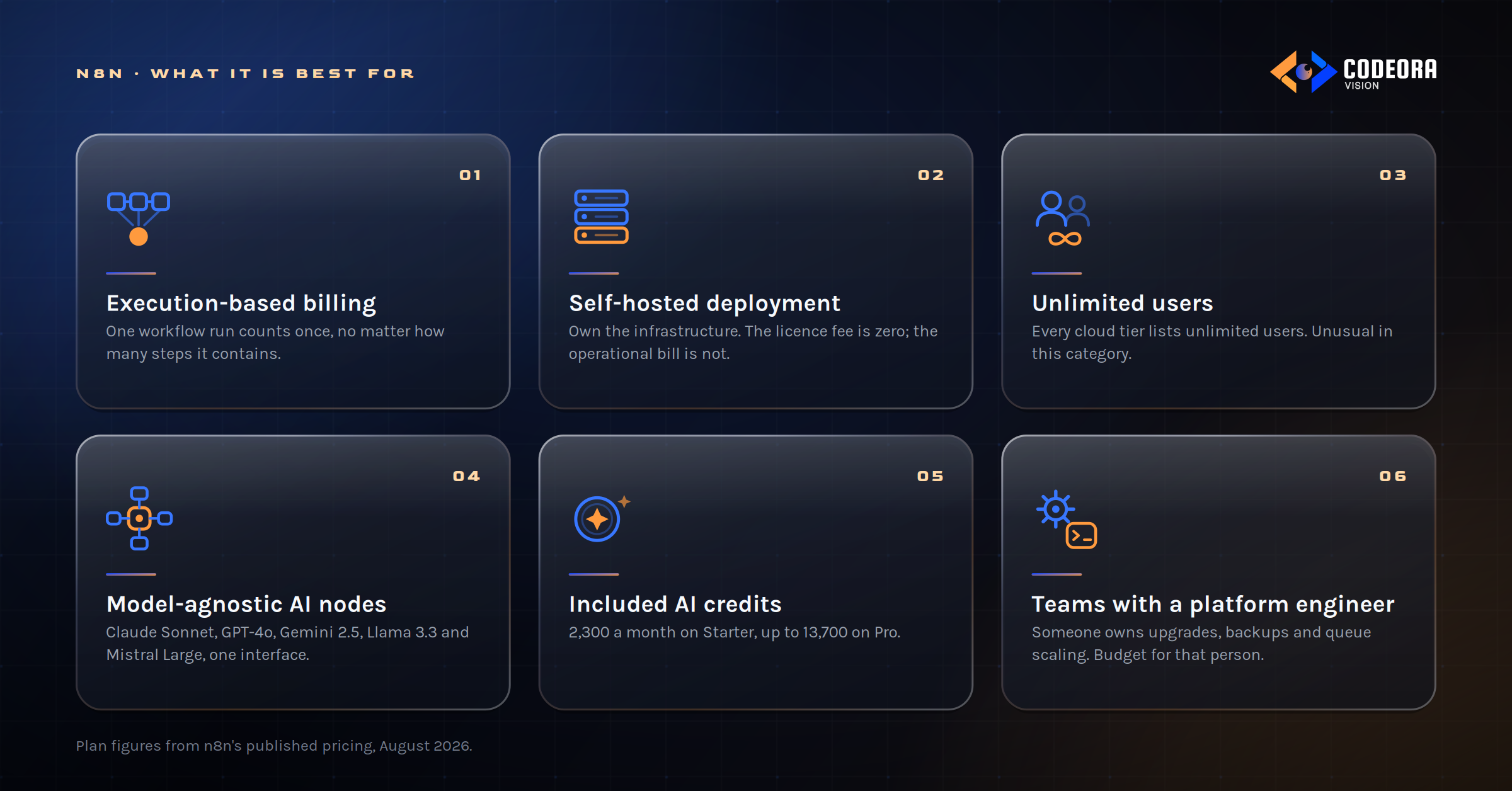
n8n is the option for teams that want to own their infrastructure and run long workflows cheaply. Its defining feature is execution-based billing. One workflow run counts once, no matter how many steps it contains. On n8n's own pricing page in August 2026, Starter lists at 20 euros per month for 2,500 workflow executions.
Pro lists at 50 euros per month for 10,000 executions, and Business at 667 euros per month for 40,000 executions with self-hosted deployment. All cloud tiers list unlimited users, which is unusual in this category. Enterprise is quoted rather than published and lists 200-plus concurrent executions.
The AI allocation is explicit. Starter includes 2,300 AI credits per month and Pro up to 13,700. Its AI nodes reach Claude Sonnet, GPT-4o, Gemini 2.5, Llama 3.3, and Mistral Large through one interface. Swapping models is a configuration change rather than a rebuild.
The licensing detail most comparisons get wrong. n8n is frequently described as open source. It is not. The code ships under the Sustainable Use License. That licence permits use "only for your own internal business purposes or for non-commercial or personal use." It also restricts providing the software to others as a hosted service. n8n calls this fair-code, because the Open Source Initiative definition forbids field-of-use restrictions.
What self-hosting actually costs. The licence fee is zero and the operational bill is not. Someone owns upgrades, database backups, queue mode scaling, and incident response at 2am. Teams with a platform engineer absorb this easily. Teams without one often discover the cost after the first failed upgrade.
Where it loses. The learning curve is real, self-hosting transfers operational burden to you, and the connector catalogue trails both rivals.
KEY TAKEAWAY
n8n bills one execution per workflow run regardless of step count, listing at 20 euros per month for 2,500 executions in August 2026. Its Sustainable Use License is source-available fair-code, not open source.
Zapier: what is it best for?
Zapier is the correct choice for non-technical teams and for reaching obscure software. It lists 9,000-plus apps, the largest catalogue of the three. The trade is its pricing unit. Zapier bills per task, where one task is one action completed, so an eight-action workflow consumes eight tasks per run.
Published tiers as of August 2026 start with a Free plan at 100 tasks per month for one user. Professional starts at 19.99 dollars per month billed annually, or 29.99 monthly, at the 750-task tier. Team starts at 69 dollars per month annually, or 103.50 monthly, covering 2,000 tasks and 25 users.
Annual billing is discounted 33% against monthly. Both Professional and Team scale to 2,000,000 tasks per month at the top of their ranges. The ceiling is high and so is the bill.
On AI. Zapier ships AI features on paid tiers, including agent-style automations. They inherit the task meter, which is the structural problem. An agent that reasons, retries, and self-corrects generates exactly the extra actions the billing model charges for.
Where it wins outright. Time to first working automation is the shortest of any platform here, and that has real value for a team with no engineering support.
Where it loses. Per-task billing punishes exactly the multi-step agent workflows the market is moving toward, and there is no self-hosted option at any price.
KEY TAKEAWAY
Zapier lists 9,000-plus apps and bills per task, so an eight-action workflow consumes eight tasks per run. Professional starts at 19.99 dollars monthly billed annually for 750 tasks, verified August 2026.
Make: what is it best for, and what else belongs on the shortlist?
Make sits between the other two on both price and difficulty. Its visual canvas handles branching more legibly than Zapier's linear editor, and it lists 3,000-plus apps. Make bills per credit, where one module execution is one credit, including routers and filters.
Published tiers in August 2026 start with Free at 1,000 credits per month and 2 active scenarios. Core lists at 9 dollars per month for 10,000 credits, Pro at 16 dollars, and Teams at 29 dollars. All paid tiers list unlimited active scenarios and scale to 8,000,000-plus credits. Annual billing saves 15% or more.
The detail to watch. Because routers and filters consume credits, structural complexity is billable on Make in a way it is not on n8n. AI modules are metered variably by consumption rather than at one credit each.
Where the canvas earns its keep. Make's error-handling routes are drawn on the same canvas as the happy path, so failure behaviour is visible rather than buried in settings. On Zapier that logic is harder to see at a glance.
KEY TAKEAWAY
Make bills one credit per module execution, so routers and filters are billable. Core listed at 9 dollars monthly for 10,000 credits in August 2026, and Activepieces is MIT-licensed where n8n is not.
How do n8n, Zapier, and Make compare side by side?
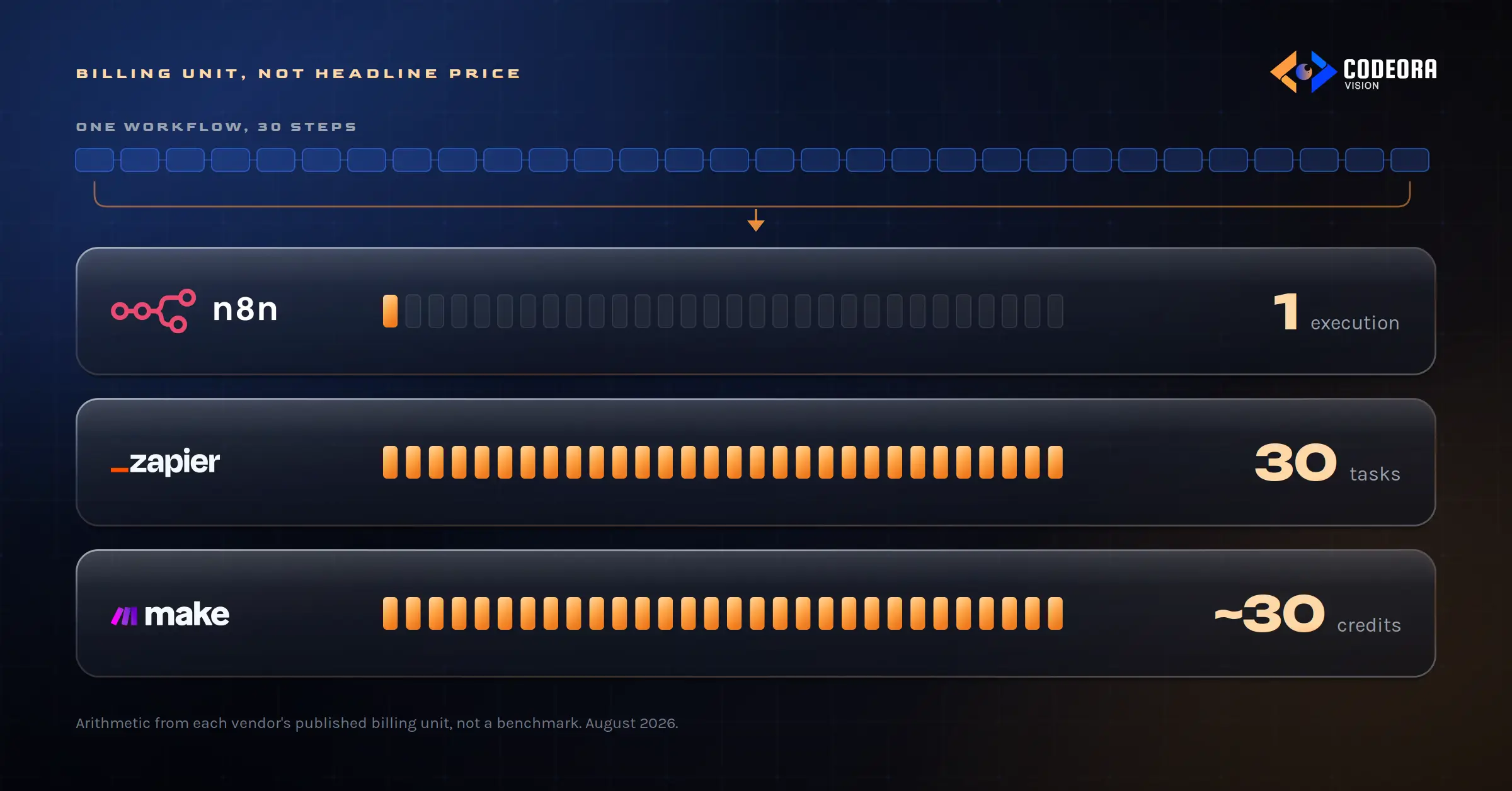
The three diverge most on billing unit and deployment, and least on the integrations most businesses actually use. All three connect ecommerce platforms such as Shopify, HubSpot, Slack, Zendesk, and Twilio. The table below carries the six weighted criteria from the methodology section. Billing unit is the row that moves budgets.
| CRITERION | N8N | ZAPIER | MAKE |
|---|---|---|---|
| Billing unit | Workflow execution, unlimited steps | Task, one per action | Credit, one per module execution |
| Entry paid tier (Aug 2026) | 20 €/mo, 2,500 executions | $19.99/mo annual, 750 tasks | $9/mo, 10,000 credits |
| Cost of a 30-step workflow | 1 execution | 30 tasks | ~30 credits |
| Self-hosting | Yes, Community Edition and Business tier | No | No |
| Licence | Sustainable Use License, fair-code | Proprietary | Proprietary |
| Stated app catalogue | Smallest of the three | 9,000+ | 3,000+ |
| AI agent fit | Strongest, steps are free | Weakest, retries multiply tasks | Middle, AI modules metered by use |
| Users on entry tier | Unlimited | 1 | Seat-based by tier |
| Learning curve | Steepest | Shallowest | Middle |
The 30-step row is the one that decides most budgets. It is arithmetic from each vendor's published billing unit, not a benchmark.
KEY TAKEAWAY
A 30-step workflow costs one n8n execution, roughly 30 Make credits, and 30 Zapier tasks. Billing unit, not headline price, produces the cost divergence between the three platforms.
How should you choose between n8n, Zapier, and Make?
Choose on step count, engineering capacity, and data control, in that order. The n8n vs Zapier vs Make decision resolves cleanly once those three are known, and headline price is the weakest signal of the four. Each platform below wins a specific situation outright.
Choose Zapier when nobody on the team writes code, workflows are short, and a niche connector is load-bearing. Shortest path to working automation.
Choose Make when workflows branch heavily and a visual canvas helps, and when nobody needs to self-host. Its per-module billing is tolerable until structural complexity grows.
Choose n8n when workflows are long, when AI agent loops are involved, or when data must stay on infrastructure you control. Execution billing makes step count free.
Choose something else when the constraint is governance rather than workflow, which points at Workato. An organization already running Microsoft 365 should look at Power Automate.
Choose none of them when the workflow outgrows a canvas entirely and requires custom AI solutions. At that point the alternatives are code-level orchestrators such as LangChain, CrewAI, Pydantic AI, and Temporal. They trade the visual editor for version control and real testing.
A realistic sequence beats a single choice. Start where the friction is lowest, then migrate the small number of workflows that become expensive. Most teams over-buy at the start and under-plan the migration.
KEY TAKEAWAY
Choose on step count, engineering capacity, and data control rather than headline price. Zapier suits short workflows with no engineering support, Make suits heavy branching, and n8n suits long or agentic workflows.
What are the most common mistakes when choosing an automation platform?
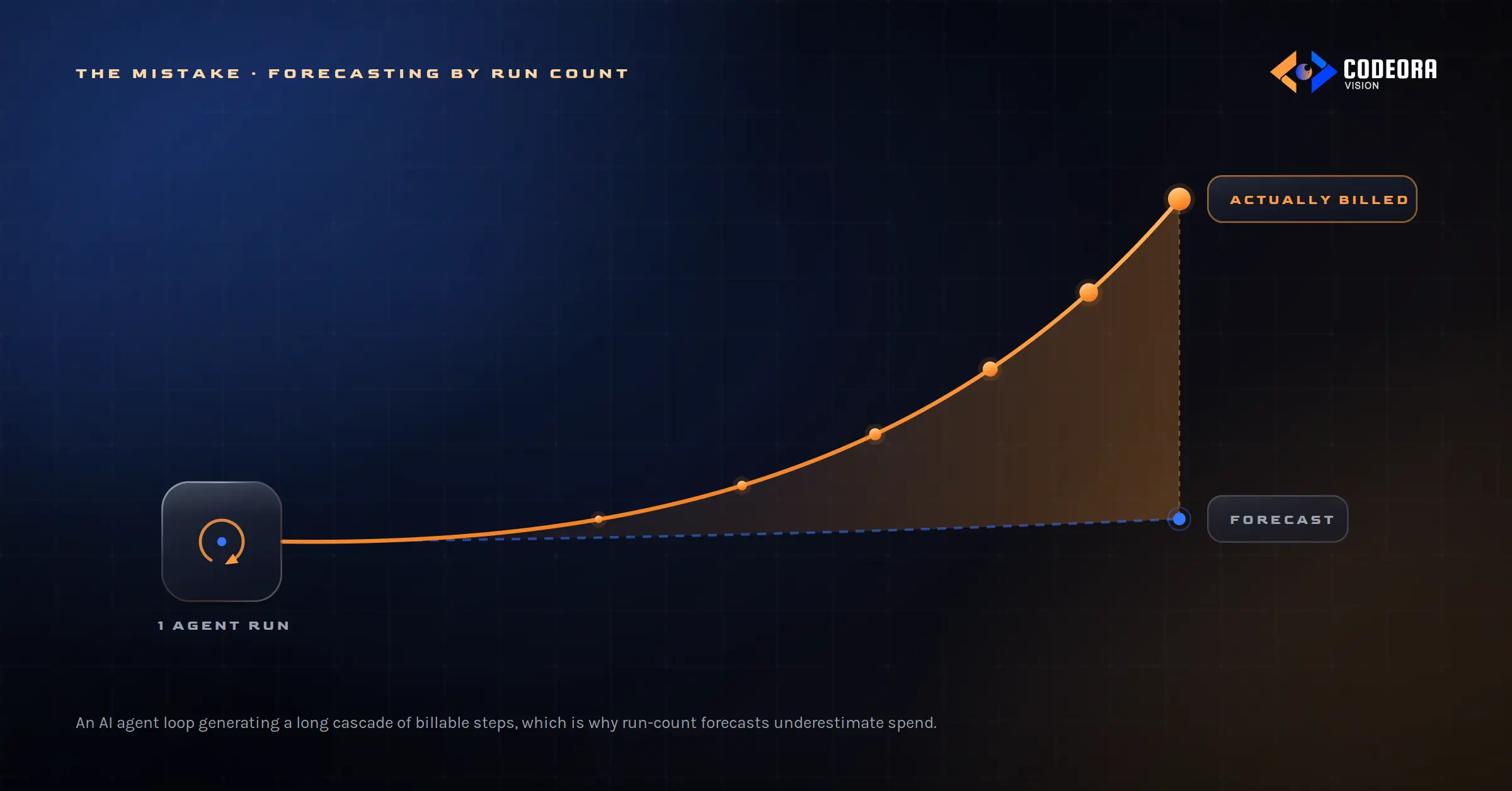
The costliest mistake is forecasting spend on run count rather than step count. A team modelling 1,000 runs per month on Zapier at eight actions each is buying 8,000 tasks, not 1,000. That single error produces most of the surprise bills in this category.
Assuming n8n is open source. It is source-available under the Sustainable Use License. Teams that plan to resell hosted n8n discover the restriction late.
Treating self-hosting as free. The licence costs nothing and the operations cost real engineering time, including upgrades, backups, and incident response.
Ignoring migration cost. No meaningful import path exists between these platforms, so a switch is a rebuild.
Buying for an agent roadmap that has not shipped. Gartner forecast over 40% of agentic AI projects may be cancelled by 2027. The τ-bench study found leading function-calling models solve under 50% of multi-step tasks. Consistency was worse, with pass^8 below 25% in retail.
How Codeora Vision approaches this, and what we charge
We are not a platform, and we are not a competitor to the nine above. We build on them. Most agencies still build with last year's stack — we build with LangGraph, MCP, Claude — agent-native, not retrofitted.
Our default is n8n for orchestration where the client can self-host. LangGraph handles workflows that need genuine agent branching. Zapier wins where a non-technical team owns the system after handover. We recommend Zapier against our own commercial interest often, because a client who cannot maintain what we build has not been served.
Published pricing, per Lock 8: single-channel builds from $5,000, multi-channel with CRM or PMS integration from $10,000, and custom multi-agent work at $20,000–$30,000+. Monthly is flat support, quoted with scope. Where a platform subscription solves the problem for $9 a month, we say so.
The honest constraint: What we publish alongside the architecture is the outcome. Every deployment we describe is anonymized by vertical under client confidentiality, and every figure reflects a single engagement rather than a guaranteed result. One system we can show you in full is our own: the multi-agent SEO pipeline that took two to three people 20 to 25 hours per output and now takes one person one hour. No NDA on that one — ask and we will run it live.
For orchestration work spanning several systems, that sits in agentic workflow automation built on n8n and LangGraph.
KEY TAKEAWAY
The most expensive mistake is forecasting automation spend on run count rather than step count. A 1,000-run month at eight actions each consumes 8,000 Zapier tasks, not 1,000.
Frequently asked questions
No, and n8n does not claim to be. The code ships under the Sustainable Use License, permitting use "only for your own internal business purposes or for non-commercial or personal use." It restricts providing the software to others as a hosted service. n8n calls this fair-code, because the Open Source Initiative definition forbids field-of-use restrictions.
n8n, because execution-based billing does not penalize the many steps an agent loop generates. A Zapier agent that retries five times consumes five times the tasks. n8n allocates 2,300 AI credits monthly on Starter and up to 13,700 on Pro. All three face the same ceiling: τ-bench found leading models solve under 50% of multi-step tasks.
Usually, and the gap widens as workflows lengthen. n8n counts one execution per run regardless of steps, so a 30-step workflow costs the same as a 3-step one. Zapier counts one task per action, making the same workflow roughly ten times more expensive. Self-hosted n8n Community Edition removes the per-run cost entirely.
They meter three different things. A Zapier task is one action completed. A Make credit is one module execution, including routers and filters, so structural steps are billable. An n8n execution is one workflow run with unlimited steps. This is the single largest driver of cost divergence between the three platforms.
No. Both are cloud-only, so all workflow data transits vendor infrastructure. n8n publishes a self-hostable Community Edition on GitHub, and its Business tier lists self-hosted deployment. Activepieces and Windmill are also self-hostable. Self-hosting matters most where data residency or sector compliance is a requirement rather than a preference.
At the edges, not in the middle. Zapier lists 9,000-plus apps against Make's 3,000-plus, but both cover the systems most businesses run, including Shopify, HubSpot, Slack, and Zendesk. Catalogue size decides the outcome only when a niche tool is load-bearing. A generic HTTP node reaches any REST API regardless.
Usually not as a first platform. n8n assumes comfort with data structures and expressions, and self-hosting adds infrastructure ownership. Zapier is the lowest-friction option for a team with no engineering support. The realistic path starts on Zapier or Make, then migrates the workflows that become expensive.
Harder than vendors imply, because no meaningful import path exists. Triggers, authentication, error handling, and data-shape assumptions all get rebuilt by hand. Budget it as new work. Keeping business logic documented outside the platform means a migration re-implements a specification rather than reverse-engineering a canvas.
Sources cited in this post: n8n pricing · n8n Sustainable Use License, LICENSE.md · Zapier pricing · Make pricing · McKinsey, The State of AI in 2025 · Yao, Shinn, Razavi, Narasimhan, τ-bench, arXiv 2406.12045
Related Codeora Vision resources: agentic workflow automation built on n8n and LangGraph · custom agentic AI solutions and multi-agent architecture · AI chatbot development services for support teams · private LLM and RAG knowledge systems · automated lead generation for outbound teams · AI automation services for operations teams · ecommerce automation for Shopify merchants · law firm intake services and matter automation · the six types of AI automation for small business · AI agent vs AI chatbot: which one the work needs
RELATED CODEORA VISION SERVICES
Build this with us
Workflow Automation
Agentic orchestration built on n8n and LangGraph, with retries, audit logs, and human approval gates on every write.
ExploreCustom AI Solutions
Multi-agent architecture for workflows that have outgrown a canvas entirely, scoped to the actions your business needs.
ExploreAI Chatbot Development
Retrieval-grounded chat that answers from your own documents and deflects tickets without inventing policy.
ExploreRELATED BLOGS
Keep reading
AI Automation for Small Business: 6 Types That Actually Work
The six automation types, the five real cost drivers, and why most generative AI pilots return nothing.
13 min read AGENT ARCHITECTUREAI Agent vs AI Chatbot: What's the Difference?
A chatbot answers, an agent acts. When each one is the right call, and what the reliability ceiling means.
9 min read RAGRAG That Actually Cites Your Documents
Chunking, reranking, and eval design for retrieval systems that ground answers instead of hallucinating.
11 min readFREE CONSULTATION
Choosing a platform? Let's scope it
30 minutes, under NDA. We map your workflows, forecast spend on step count rather than run count, and tell you which platform fits.
Book a free consultationNo spam. No sales sequence.