
ON THIS PAGE
An AI voice agent in healthcare holds a real phone conversation with a patient and writes the outcome into the EHR. It books, reschedules, verifies eligibility, and chases refills. Vendors advertise 60% to 85% call deflection. Production figures across a full call mix sit closer to 30% to 50%. Containment of 70% on scheduling that is 40% of inbound means 28% total deflection. Build cost starts from $5,000 for a single channel, and EHR credentialing usually sets the timeline.
An AI voice agent in healthcare answers or places a call, understands free speech, and completes a transaction inside the electronic health record. Speech recognition transcribes the audio. A language model decides what the caller wants. An integration layer executes the action against Epic, Oracle Health, athenahealth, or eClinicalWorks.
Three workloads account for most deployments. Inbound reception covers booking, rescheduling, and directions. Administrative and revenue cycle work covers eligibility checks, billing questions, and payer phone trees. Outbound covers reminders, post-discharge follow-up, and care-gap outreach.
Clinical judgment sits outside all three. A correctly scoped agent routes any symptom description to a person. It does not attempt assessment of its own.
That boundary is not only clinical caution. It is also what keeps the software out of medical device territory, which §9 covers in detail.
KEY TAKEAWAY
An AI voice agent in healthcare is defined by its write path into the EHR, not by how natural the voice sounds. Three workloads dominate: inbound reception, revenue cycle calls, and outbound follow-up.
Phone work has become a measurable financial drag. Prior authorization is the clearest case, and the numbers are well documented. An American Medical Association survey of 1,000 practising physicians found 39 prior authorization requests per physician each week. That survey was fielded in December 2024.
Practices spend roughly 13 hours a week on those requests. In the same survey, 89% of physicians said prior authorization contributes to burnout. Another 93% reported care delays, and 29% reported a serious adverse event for a patient in their care.
A healthcare AI voice agent is a capacity answer to that specific burden. Payer phone trees are deterministic, repetitive, and measured in staff hours rather than clinical skill.
Readmissions carry a second bill. Under the CMS Hospital Readmissions Reduction Program the maximum penalty reaches 3% of Medicare payments, and §8 explains what that percentage applies to.
KEY TAKEAWAY
An American Medical Association survey of 1,000 physicians found 39 prior authorization requests per physician weekly. Practices spend roughly 13 hours a week on them, and 89% link the process to burnout.
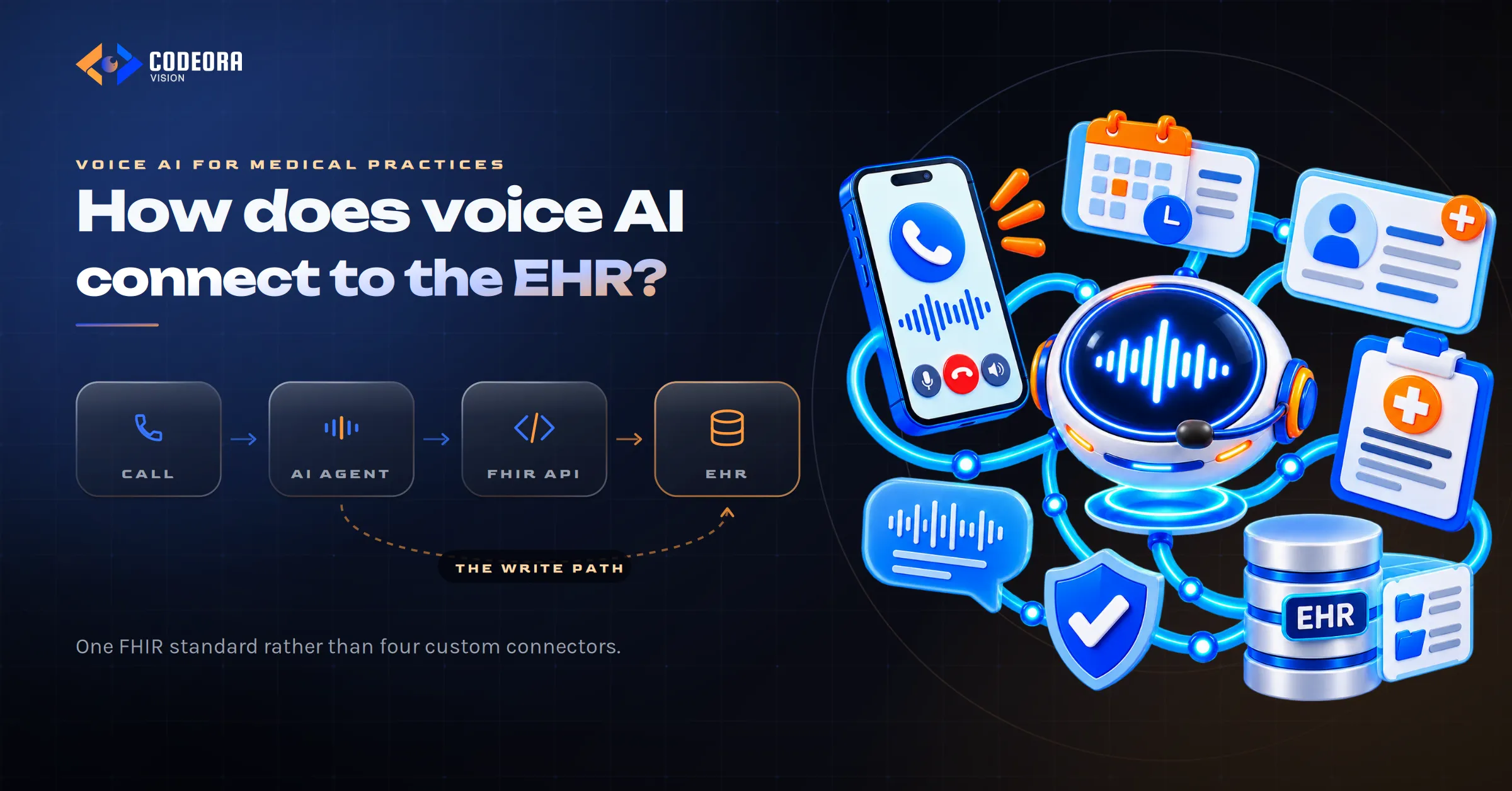
Through a federally mandated API, which is the reason this works at all. Certified health IT must expose a standardized FHIR interface under 45 CFR 170.315(g)(10). The current requirement is the HL7 FHIR US Core Implementation Guide STU 6.1.0, supporting USCDI v3, with SMART App Launch 2.0.0 handling authorization.
Voice AI for medical practices therefore reaches Epic, Oracle Health, athenahealth, and eClinicalWorks through one standard rather than four custom connectors. Certified API developers must also publish their service base URLs in FHIR format, free of charge.
Telephony and speech sit in front of that. Twilio or a comparable carrier accepts the call. Deepgram or a similar engine transcribes it in near real time.
Read access is the easy half. Writing a confirmed booking back into the chart needs scoped credentials and appointment-type mapping that no standard supplies. Oracle Health and eClinicalWorks expose the same standard through different sandbox processes. Practices on AdvancedMD or NextGen Healthcare meet the same pattern with different paperwork.
KEY TAKEAWAY
Certified health IT must expose a FHIR API under 45 CFR 170.315(g)(10), currently US Core STU 6.1.0 with USCDI v3. That federal mandate is what removes the need for a custom connector per EHR vendor.
Four categories, with sharply different reliability profiles. An AI voice assistant for healthcare performs well on deterministic, well-scoped work and badly on anything requiring clinical judgment. The table separates the two, and the escalation column is the one worth reading first.
| Workload | Examples | Reliability | Human escalation |
|---|---|---|---|
| Inbound reception | Booking, rescheduling, hours, directions | High | Rare |
| Revenue cycle | Eligibility checks, billing questions, payer phone trees | High | On exception |
| Outbound engagement | Reminders, post-discharge calls, care-gap outreach | High | On patient request |
| Clinical triage | Symptom assessment, severity sorting | Out of scope | Always |
Payer phone trees deserve particular attention. They are the least glamorous target and the highest-yield one, because the work is repetitive and the saving is measured directly in staff hours.
Reliability tracks how deterministic the task is. Booking a slot has one correct outcome and a clear confirmation. Interpreting a described symptom has many possible readings, which is why the final row escalates without exception.
Outbound has peer-reviewed support behind it. Penn Medicine added automated voice calls to an existing text reminder programme, targeting patients its EHR predictive model had flagged as high risk. That result appeared in NEJM Catalyst in May 2026.
KEY TAKEAWAY
Payer phone-tree traversal is the highest-yield voice workload, because the work is deterministic and the saving is measured in staff hours. Clinical triage sits outside scope and escalates every time.
Codeora Vision publishes three build tiers with no project ceiling. A single-channel build starts from $5,000. Multi-channel work with CRM, EHR, or PMS integration starts from $10,000. Custom multi-agent architecture runs $20,000–$30,000+. Ongoing work is flat monthly support, quoted with scope.
| Tier | Scope | Published figure |
|---|---|---|
| Single-channel | One channel, one system | from $5,000 |
| Multi-channel | Multiple channels with CRM, EHR, or PMS integration | from $10,000 |
| Custom multi-agent | Multi-agent architecture with orchestration | $20,000–$30,000+ |
| Ongoing | Support, monitoring, iteration | Flat monthly support, quoted with scope |
The build figure rarely decides the budget. Credentialing against a certified EHR runs on the vendor's timetable rather than yours. That single dependency is what moves a project from six weeks to twelve.
Tier selection follows integration count rather than call volume. One system is a single-channel build. A CRM plus an EHR plus a billing platform is not, regardless of how few calls arrive.
Recurring cost sits underneath, separately. Telephony, speech recognition, and model inference each meter per minute or per token. Volume growth therefore appears on the invoice before it appears anywhere else.
KEY TAKEAWAY
Codeora Vision publishes single-channel builds from $5,000, multi-channel with EHR integration from $10,000, and custom multi-agent at $20,000–$30,000+. EHR credentialing, not build complexity, usually sets the timeline.
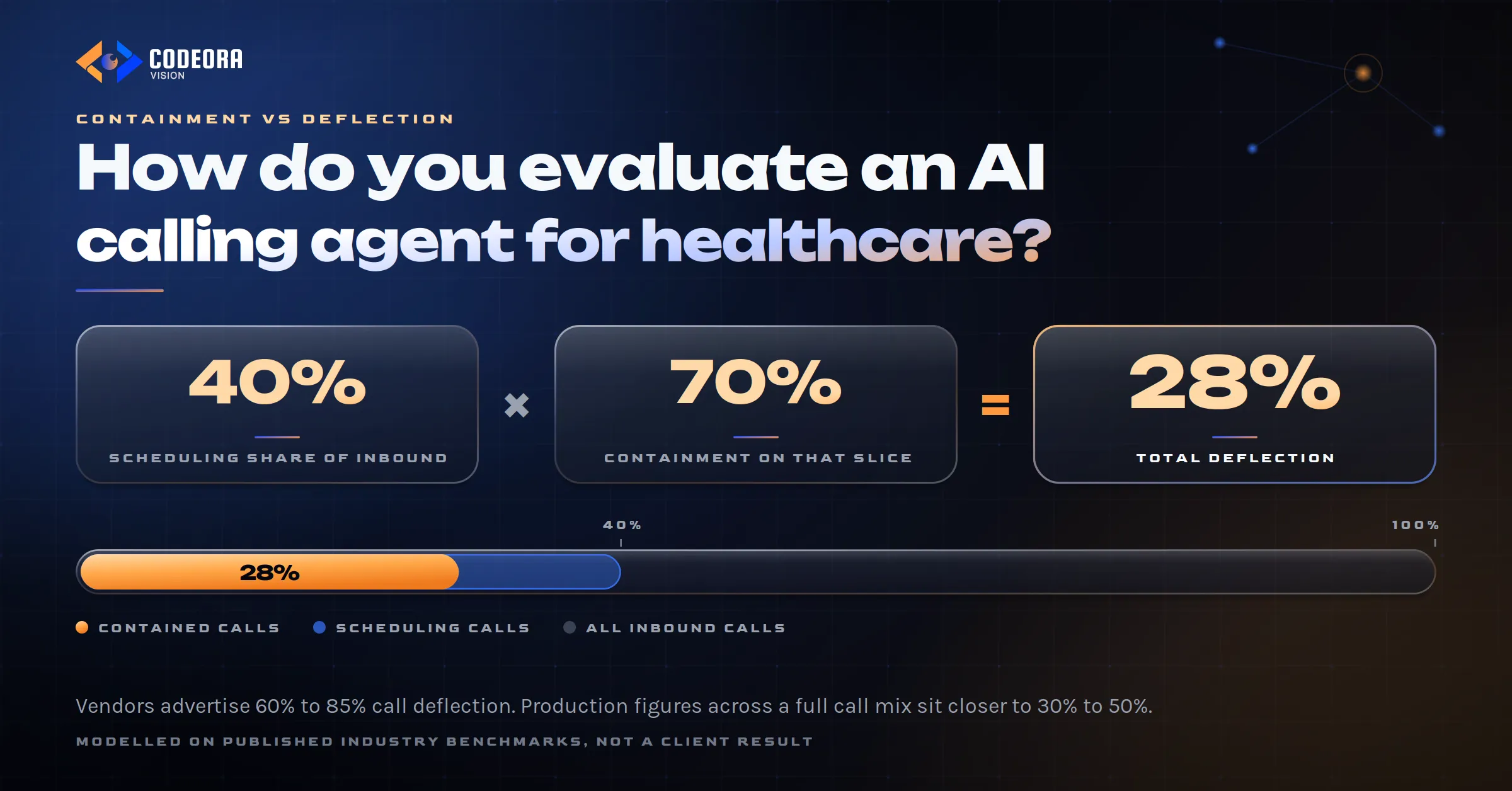
Start with the deflection claim, because it is almost always inflated. Ask which call types the quoted figure covers. Then ask what share of inbound volume those types represent. A vendor quoting 70% containment on scheduling describes one slice of the phones.
Run the arithmetic yourself. If scheduling is 40% of inbound, then 70% containment on that slice deflects 28% of total calls. Published production figures across a full call mix sit closer to 30% to 50%, well under the 60% to 85% that vendor pages advertise.
Model choice is the second lever, rarely disclosed. Any AI calling agent for healthcare routes to something underneath, usually Claude Sonnet, GPT-4o, or Gemini 2.5. Open-weight options such as Llama 3.3 appear where data residency matters.
Then ask the contractual questions. Who signs the Business Associate Agreement, and does that cover the speech vendor and the model provider as well as the interface layer?
Buyers comparing AI voice agents for healthcare deployments should run all four checks first. Most vendor pages answer none of them without being asked directly.
KEY TAKEAWAY
Containment on one call type is not deflection across all of them. At 70% containment on scheduling that represents 40% of inbound, total deflection is 28%.
Three workstreams run in parallel and only one is conversational. Telephony through Twilio and speech through Deepgram can be live within days. EHR credentialing and escalation design set the actual date, and six to ten weeks is realistic. Sequencing is what most plans get wrong.
Voice agent AI deployment in healthcare systems follows a sequence worth respecting. Scope one call type. Instrument it against a measured baseline. Prove it. Then widen. Teams that widen before instrumenting pay for the same work twice.
Escalation design is the step most often skipped. Every symptom keyword, every distressed caller, and every request the agent cannot complete needs a named destination and a tested handoff. That logic belongs outside the language model rather than inside its prompt.
Orchestration frameworks differ on how they hold that state. LangGraph treats branching as the primary work. The Claude Agent SDK covers similar ground with a tighter tool-calling surface.
KEY TAKEAWAY
Telephony and speech can be live in days. EHR credentialing and escalation design set the real timeline at six to ten weeks.
Setting changes the answer more than practice size does. The variable is call mix, specifically what share of inbound is administrative rather than clinical. A practice whose phones are dominated by symptom calls will automate a small slice of a large problem.
Primary care and high-volume specialty clinics sit at the favourable end. Scheduling, refills, and eligibility checks dominate those phones, and all three are deterministic. Dental practices follow the same pattern with a narrower appointment taxonomy, which makes the booking logic simpler to build.
Hospitals and health systems have a different lever entirely. The CMS readmissions adjustment applies to all Medicare fee-for-service base operating DRG payments for every discharge. It is not limited to the readmitted patients themselves.
That distinction changes the arithmetic. A penalty assessed across the whole book makes automated post-discharge outreach cheap insurance rather than a marginal efficiency.
Six conditions carry the measure, including heart failure, pneumonia, and COPD. A follow-up call placed within days of discharge is the cheapest intervention available against any of them.
KEY TAKEAWAY
The CMS readmissions penalty applies to every Medicare fee-for-service discharge, not only to readmitted patients. That is what makes automated post-discharge outreach economically attractive at hospital scale.
Two risks sit on different timescales. One is a classification question that most buyers have never asked. The other is the slow erosion of a business case that nobody is measuring. Both are avoidable, and both are cheaper to handle before launch than after it.
The FDA published revised clinical decision support guidance on January 6, 2026, superseding its 2022 version. Four criteria decide whether software escapes medical device classification. They cover the data type used, the nature of the output, the practitioner's role, and transparency sufficient for independent review.
The 2026 revision relaxed the rules, and that cuts both ways. Software offering a single clinically appropriate recommendation can now stay outside device regulation where it previously could not. Less federal screening moves the diligence burden onto the buyer.
An agent confined to scheduling, eligibility, and refills is not clinical decision support at all. Exposure begins when somebody adds symptom questions to the script without reassessing scope.
Scope drift, mostly. Gartner warned on August 26, 2025 that over 40% of agentic AI projects may be cancelled by 2027. Healthcare deployments tend to fail at the integration layer rather than the conversation layer.
Agents break on the fourth conditional branch rather than the first. A caller rescheduling for a parent, with a secondary insurance change, hits a path nobody scripted. McKinsey surveyed 1,993 respondents and found no more than 10% of firms scaling AI agents inside any single function.
HIPAA obligations attach throughout and do not relax. Encryption in transit and at rest, role-based access control, and audit logging on every ePHI touch are build requirements rather than optional features.
KEY TAKEAWAY
The FDA revised its clinical decision support guidance on January 6, 2026, relaxing oversight. Less federal screening moves the diligence burden onto the practice buying the system.
We build these rather than resell them. One can be shown in full, because it is our own. Codeora Vision replaced an internal content pipeline that took two to three people 20 to 25 hours per cycle. One person now runs it in about an hour.
Most agencies still build with last year's stack — we build with LangGraph, MCP, Claude — agent-native, not retrofitted. That means Claude Sonnet or Claude Opus handling intent, with LangGraph holding state across branches. The Model Context Protocol exposes the EHR as a governed tool surface. Temporal retries failed writes, and LangSmith traces every call.
Tracing makes containment measurable rather than asserted. Without it, month one's deflection rate is simply repeated at month twelve.
Modelled on published industry benchmarks, not a client result. A practice where scheduling is 40% of inbound, with containment at 70%, deflects 28% of total calls. Before state is every call ringing to the desk. Build timeline runs six to ten weeks.
KEY TAKEAWAY
Codeora Vision's multi-agent pipeline once took two to three people 20 to 25 hours per cycle. One person now runs it in about an hour, a single internal engagement rather than a guarantee.
Definition: software that holds a real phone conversation and writes the result into the EHR. The write path is the hard part, not the voice.
Three workloads: inbound reception, revenue cycle and payer calls, outbound follow-up. Clinical triage is out of scope and escalates every time.
Integration: certified health IT must expose FHIR under 45 CFR 170.315(g)(10), currently US Core STU 6.1.0 with USCDI v3 and SMART App Launch 2.0.0.
The number to interrogate: 70% containment on scheduling at 40% of inbound is 28% total deflection, not 70%.
Published production range: roughly 30% to 50% across a full call mix, against vendor claims of 60% to 85%.
Prior authorization: 39 requests per physician weekly and about 13 hours, per an American Medical Association survey of 1,000 physicians fielded December 2024.
Hospital lever: the CMS readmissions penalty reaches 3% and applies to every Medicare fee-for-service discharge, not only readmissions.
Regulatory line: administrative scope stays outside FDA device rules. Adding symptom questions to the script changes that analysis.
Build cost: from $5,000 single-channel, from $10,000 with EHR integration, $20,000–$30,000+ for custom multi-agent.
It is software that holds a real phone conversation with a patient and writes the outcome into the EHR. Typical work includes booking, rescheduling, eligibility checks, refill routing, and post-discharge follow-up. Clinical assessment sits outside scope. A correctly built agent routes any symptom description to a person without attempting to evaluate it.
Compliance describes a deployment rather than a product, so no vendor is compliant on its own. The practical test is contractual. Every vendor touching protected health information needs a signed Business Associate Agreement. That includes the speech recognition service and the model provider, not only the interface layer. Ask for the subprocessor list and the recording retention policy.
Less than vendor pages claim. Advertised figures of 60% to 85% describe containment on well-scoped call types such as scheduling. Published production figures across a full call mix run closer to 30% to 50%. If scheduling is 40% of your inbound and the agent contains 70% of it, total deflection works out at 28%.
Yes, and a federal rule is the reason. Certified health IT must expose a standardized FHIR API under 45 CFR 170.315(g)(10), currently US Core STU 6.1.0 supporting USCDI v3. Reading availability is straightforward. Writing a confirmed booking back needs scoped credentials and appointment-type mapping, which is usually the longest part of the project.
Not if it stays administrative. The FDA revised its clinical decision support guidance on January 6, 2026, superseding the 2022 version. Four criteria cover data type, output, practitioner role, and transparency. Scheduling and eligibility work does not engage them. Adding symptom triage to the script is what changes the analysis.
Codeora Vision publishes single-channel builds from $5,000, multi-channel builds with EHR integration from $10,000, and custom multi-agent architecture at $20,000–$30,000+. Ongoing work is flat monthly support, quoted with scope. Telephony, speech recognition, and model inference meter separately, so recurring cost scales with call volume rather than with the build.
Six to ten weeks is realistic for a multi-channel build, and EHR credentialing dominates that window. Telephony and speech can be live within days. The sequence that controls cost is fixed. Scope one call type, instrument it against a baseline, prove it, then widen rather than launching everything at once.
The evidence points to load-shifting instead. McKinsey surveyed 1,993 respondents and found no more than 10% of firms scaling AI agents inside any single business function. Repetitive coordination moves to the agent, including payer phone trees and reminder calls. Sensitive conversations, clinical questions, and exceptions stay with people.
Sources: American Medical Association prior authorization survey · CMS Hospital Readmissions Reduction Program · ASTP/ONC Standardized API certification criterion · FDA clinical decision support guidance update, January 2026 · NEJM Catalyst, automated calls added to SMS reminders
RELATED CODEORA VISION SERVICES
Voice agents that answer, book, and write back to the EHR over FHIR, with human escalation on every symptom mention.
ExploreA front-desk agent that answers, books, and routes patient calls without a per-minute answering service.
ExploreMulti-agent architecture for workflows that span your EHR, scheduling, and billing systems.
ExploreRELATED BLOGS
What a healthcare AI receptionist handles at the front desk, the HIPAA gate, and the call mix that disqualifies it.
10 min read AI AGENTSBuild versus recurring token cost, priced from published rates and BLS wage data instead of a vendor range.
15 min read AGENT ARCHITECTUREA chatbot answers, an agent acts. When each one is the right call, and what the reliability ceiling means.
9 min readFREE CONSULTATION
30 minutes, under NDA. We map your call mix, forecast realistic deflection, and tell you where regulation stops the scope.
Book a free consultationNo spam. No sales sequence.