
ON THIS PAGE
An AI receptionist for healthcare is a voice and text agent that answers patient calls, books appointments, and writes back to the EHR. It handles scheduling, refill routing, and directions without a human. It does not perform clinical triage. A 2026 BMC Emergency Medicine meta-analysis put GPT-4 emergency triage accuracy at 0.70. Production systems pair a model like Claude Sonnet with LangGraph orchestration and a scoped Epic integration.
A healthcare AI receptionist is an automated voice and text agent that answers inbound patient calls in real time. It books, reschedules, and cancels appointments, routes refill requests, and answers routine front-desk questions. Results write back to the practice management system. It is a scheduling and routing system, not a clinical one.
Three components sit behind that. Speech recognition converts the caller's audio to text. A language model such as Claude Sonnet or GPT-4o decides what the caller actually wants. An integration layer then executes that action inside Epic, athenahealth, eClinicalWorks, or Oracle Health, formerly Cerner.
The third component is what separates a deployment from a demo. An agent that cannot write to the schedule has only taken a message. ONC Data Brief No. 84 reported that 91% of office-based physicians had adopted a certified EHR as of 2024. That brief was published in June 2026.
KEY TAKEAWAY
A healthcare AI receptionist is defined by its write path, not by its voice. Without scoped write access to Epic, athenahealth, or eClinicalWorks, the agent has taken a message rather than booked an appointment.
Call demand does not match front-desk staffing hours, and the gap is measurable. A Journal of General Internal Medicine study logged 2,208 after-hours calls from 1,397 patients at one San Francisco primary care practice. Those callers were roughly 5% of the practice population. The study was published December 20, 2024.
The timing is the difficult part. In that same dataset, 63% of after-hours calls arrived on weekends or holidays. Another 14% landed between 5pm and 7pm on weekdays. Both windows sit outside a standard front-desk shift. Repeat callers concentrate the load further. Some 25% of after-hours callers rang more than once, and one patient called 82 times.
Staffing the gap is harder than it looks. An MGMA Stat poll of 281 practice leaders found higher pay and engagement tied at 33% as the most effective front-desk retention tactics. That poll ran May 27, 2025. An AI receptionist for healthcare practices is a capacity answer to a labour-market problem, which is a narrower claim than most vendors make.
KEY TAKEAWAY
In a 2024 Journal of General Internal Medicine study, 63% of after-hours patient calls arrived on weekends or holidays. That demand curve is the actual problem an AI receptionist addresses.
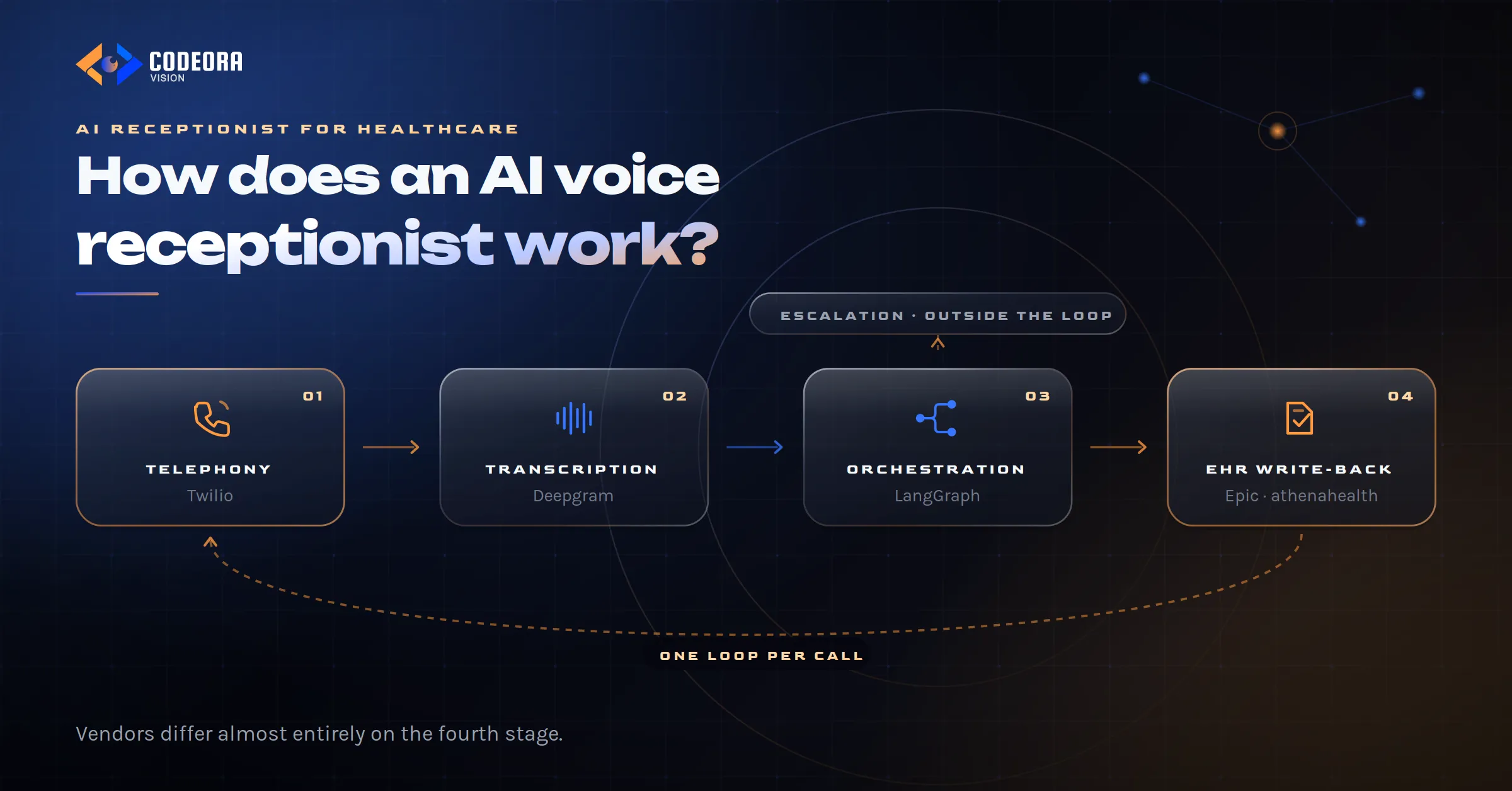
An AI voice receptionist for healthcare runs a four-stage loop on every call. Telephony accepts the call through a provider such as Twilio. Speech recognition transcribes it. An orchestration layer decides the action. An integration writes the outcome to the EHR.
Deepgram or a similar engine handles transcription. Escalation logic sits outside that loop by design. The authors of a 2026 BMC Emergency Medicine meta-analysis concluded these models belong in an auxiliary role only. Orchestration is where architecture matters most, because patients rarely state their intent cleanly. LangGraph, a framework that treats branching as the primary work rather than an exception, keeps the agent stable when callers change their mind. The Claude Agent SDK covers the same ground with a tighter tool-calling surface.
The integration layer is the most consequential. It resolves the caller against the patient record, checks provider availability, and books. Practices on AdvancedMD or NextGen Healthcare face the same pattern with different credentials. Read access is common. Scoped write access takes negotiation.
KEY TAKEAWAY
Every AI voice receptionist runs the same four stages: telephony, transcription, orchestration, and EHR write-back. Vendors differ almost entirely on the fourth, which is where Twilio and Deepgram stop being the interesting variables.
Five benefits hold up under scrutiny. Continuous availability captures the 63% of after-hours calls that the 2024 Journal of General Internal Medicine study found landing on weekends and holidays. Concurrency removes hold queues, because a number pool answers every caller at once.
Administrative offload is the third, and physicians appear to agree with the premise. The American Medical Association's 2026 Physician Survey on Augmented Intelligence found 70% believe AI can automate tasks contributing to burnout. That survey reached 1,692 physicians between January 15 and February 2, 2026.
Fourth is repeat-caller absorption, since a quarter of after-hours callers in the 2024 study rang more than once. Fifth is data capture, since every call produces a structured record rather than a sticky note. Benefits four and five are the ones that compound quietly.
KEY TAKEAWAY
The American Medical Association's 2026 survey of 1,692 physicians found 70% believe AI can automate tasks that contribute to burnout. Administrative offload, not replacement, is the benefit with the strongest published support.
No software is HIPAA compliant by itself. Compliance is a property of the deployment. Under 45 CFR 164.502(e), any vendor handling protected health information on a practice's behalf is a business associate. That vendor must execute a Business Associate Agreement.
That contract is the gate, and the risk it covers is not theoretical. The HHS Office for Civil Rights breach portal recorded 710 large healthcare breaches during 2025. HIPAA Journal's February 13, 2026 analysis attributed 128 of them, or 35.8%, to business associates rather than covered entities. Roughly 61.6 million individuals were affected across the year.
Codeora Vision holds no audit-based security certification, so the honest description is architectural rather than credentialed. AI receptionist for medical offices deployments are built with encryption in transit and at rest. Role-based access control and audit logging cover every ePHI touch. Ask any vendor for the BAA, the subprocessor list, and the call-recording retention policy.
KEY TAKEAWAY
HIPAA Journal's February 13, 2026 analysis of HHS breach portal data attributed 35.8% of 2025 healthcare breaches to business associates. A signed Business Associate Agreement is the gating item before any AI receptionist routes a patient call.
Four limits are real, and the first one disqualifies the technology outright for some practices. Clinical triage is outside scope. A BMC Emergency Medicine meta-analysis of 15 studies found pooled Emergency Severity Index accuracy of 0.70 for GPT-4 and 0.51 for GPT-3.5. It was published March 16, 2026, and its authors concluded these models belong in an auxiliary role only.
The second limit is call mix, and it is the figure vendors omit. A 2023 Annals of Medicine and Surgery study reviewed 510 after-hours calls at an academic orthopedic service. Pain accounted for 40.3% and prescription questions for 15.6%. Scheduling accounted for 0.4%.
Third, integration effort scales with EHR governance rather than with call volume. Fourth, sensitive conversations still need a person. An AI receptionist for clinics with high clinical call mix will address a small fraction of the phone burden.
AT A GLANCE
Handles well: booking, rescheduling, cancellations, directions, hours, refill routing, insurance questions
Handles badly or not at all: symptom assessment, triage, medical advice, distressed callers, complex insurance appeals
Gating requirement: a signed Business Associate Agreement under 45 CFR 164.502(e)
Timeline driver: EHR write credentials, not conversation quality
Disqualifying signal: a call mix dominated by clinical questions, as in the 2023 orthopedic study where scheduling was 0.4% of calls
KEY TAKEAWAY
A 2023 Annals of Medicine and Surgery review of 510 after-hours orthopedic calls found scheduling made up 0.4%. Call mix, not practice size, determines whether an AI receptionist is worth deploying.
No healthcare client result of ours is releasable. What follows is architecture and a benchmark scenario.
Most agencies still build with last year's stack — we build with LangGraph, MCP, Claude — agent-native, not retrofitted. That means Claude Opus handling intent and LangGraph holding conversation state. The Model Context Protocol exposes the EHR as a governed tool surface. Temporal retries dropped booking writes. LangSmith traces every turn for audit. Escalation sits outside the model, so a symptom keyword routes to a human before Claude Opus sees it.
Modelled on published industry benchmarks, not a client result. A practice matching the 2024 Journal of General Internal Medicine profile receives roughly 2,208 after-hours calls a year. Before state is voicemail for all of them. After state, at the 0.4% to 40.3% scheduling-share range in the 2023 Annals study, is between 9 and 890 calls resolved without staff. Build timeline runs six to ten weeks, mostly EHR credentialing. That is why we scope call mix first.
KEY TAKEAWAY
Codeora Vision builds healthcare voice agents on LangGraph, MCP, and Claude, with escalation held outside the model. Modelled on published benchmarks, not a client result, resolved call volume varies by roughly 100× with call mix.
No product is HIPAA compliant on its own, because compliance describes a deployment rather than software. Under 45 CFR 164.502(e), a vendor handling protected health information is a business associate and must sign a BAA. Ask for that agreement, the subprocessor list, and the call-recording retention policy before routing a single patient call.
Yes, though the write path is the hard part. Reading availability is straightforward. Writing a confirmed booking into Epic, athenahealth, eClinicalWorks, or Oracle Health needs scoped write credentials and appointment-type mapping. A deployment that only reads availability and emails the front desk has moved the manual step rather than removed it.
The correct design escalates immediately without attempting assessment. A BMC Emergency Medicine meta-analysis of 15 studies, published March 16, 2026, found pooled triage accuracy of 0.70 for GPT-4. In production, a keyword and intent layer routes any symptom mention to a human, with the language model removed from that decision entirely.
Call handling is fast, and a voice agent on Twilio and Deepgram can answer within days. The EHR write path sets the real timeline, because credentialing and sandbox testing against Epic or eClinicalWorks run on the vendor's schedule. Budget most of the project for integration rather than for conversation quality.
Published evidence points to load-shifting rather than replacement. An MGMA Stat poll found pay and engagement tied at 33% as the top front-desk retention tactics. That poll reached 281 practice leaders on May 27, 2025, and it describes a hiring problem. Routine scheduling moves to the agent. Sensitive and clinical conversations stay with people.
A phone tree routes by menu press and holds no state. An agent parses free speech, resolves the caller against the patient record, and completes the booking. It also answers concurrently. A menu tree at 9pm on a Saturday still produces voicemail. That is when 63% of after-hours calls arrived in the 2024 Journal of General Internal Medicine study.
Sources: AMA 2026 Physician Survey on Augmented Intelligence · ONC Data Brief No. 84, June 2026 · Nguyen et al., Journal of General Internal Medicine, December 20, 2024 · Gao et al., BMC Emergency Medicine, March 16, 2026 · Tideman et al., Annals of Medicine and Surgery, April 3, 2023 · MGMA Stat, May 27, 2025
RELATED CODEORA VISION SERVICES
custom AI receptionist for small business on Vapi, Retell AI, and Twilio, agent-native, not retrofitted.
ExploreAgentic orchestration built on n8n and LangGraph, with retries, audit logs, and human approval gates on every write.
ExploreRetrieval-grounded systems with evaluation harnesses, so answers stay accurate as your documents change.
ExploreRELATED BLOGS
Compared on pricing model, licensing, and AI agent support, with every figure read from a vendor pricing page.
12 min read AGENT ARCHITECTUREA chatbot answers, an agent acts. When each one is the right call, and what the reliability ceiling means.
9 min read AUTOMATIONThe six automation types, the five real cost drivers, and why most generative AI pilots return nothing.
13 min readFREE CONSULTATION
30 minutes, under NDA. We scope your call mix, EHR write access, and BAA status, and tell you honestly whether it is worth building.
Book a free consultationNo spam. No sales sequence.