ON THIS PAGE
AI workflow automation tools for small business split into CRM-native platforms, AI-agent platforms, and general connectors. GoHighLevel starts at $97 per month and Lindy at $29.99 per user. Microsoft Power Automate Premium lists at $15 per user paid yearly, and n8n at 20 euros. Only HubSpot offers a permanent free tier. The right pick depends on who maintains the workflow after launch.
The category split into three shapes: CRM-native platforms, AI-agent platforms, and general connectors. AI changed what each can attempt, because a model reads input that varies instead of matching a fixed field. Gartner forecast in August 2025 that 40% of enterprise applications will embed task-specific AI agents by the end of 2026, up from under 5%.
Small business adoption is real but shallow. U.S. Chamber of Commerce research with Teneo Research, published August 18, 2025, found 58% of small businesses using generative AI, up from 40% in 2024.
Depth is where it thins out. McKinsey's 2025 State of AI survey (n=1,993) found 23% of organizations scaling an agentic system, with 39% still experimenting.
The failure rate should shape the budget. MIT Media Lab's Project NANDA reported roughly 95% of organizations seeing no measurable profit-and-loss return from generative AI pilots.
KEY TAKEAWAY
AI workflow automation for small business now spans CRM-native platforms, AI-agent platforms, and general connectors. 58% of small businesses used generative AI in 2025, up from 40% in 2024 (U.S. Chamber of Commerce with Teneo Research, August 18, 2025).
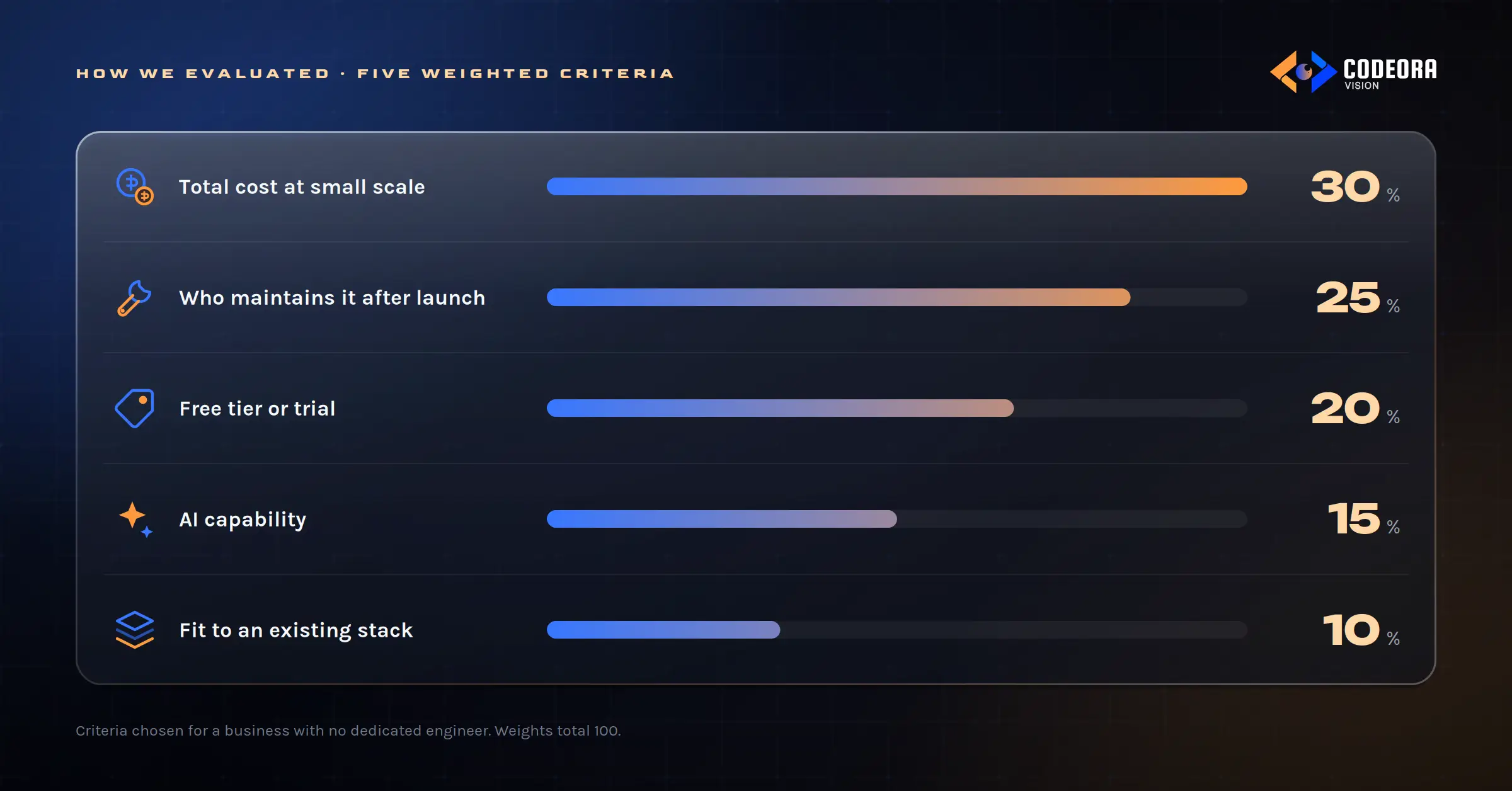
Nine tools were assessed against five weighted criteria chosen for a business with no dedicated engineer. Every price was read from the vendor's own pricing page on August 31, 2026. None came from a comparison blog.
The criteria and weights. Total cost at small scale, 30%. Who maintains it after launch, 25%. Free tier or trial, 20%. AI capability, 15%. Fit to an existing stack, 10%.
What was excluded, and why. No vendor benchmarks, no affiliate rankings, no review-aggregate scores, because none discloses methodology. Support quality was excluded as unmeasurable without a controlled test. Enterprise tiers were excluded because none of the nine publishes enterprise pricing.
Two limitations, stated rather than hidden. Pricing pages are geo-localized, so n8n returned euro pricing while the others returned US dollars. Each figure carries the currency observed, with no conversion. HubSpot's Starter price is promotional against a higher list price, and both are given.
KEY TAKEAWAY
This comparison weights total cost at small scale at 30% and maintenance ownership at 25%. Every price was read from a vendor pricing page on August 31, 2026, and review-aggregate scores were excluded.
GoHighLevel suits agencies and multi-location businesses that want CRM, marketing, and automation in one system. It is not a general connector, and it is not cheap. Pricing starts at $97 per month for Starter, covering 3 sub-accounts with unlimited contacts and unlimited users. There is no free tier.
Verified on August 31, 2026: Starter at $97 monthly or $970 annually. Unlimited runs $297 monthly or $2,970 annually, and Agency Pro $497 monthly or $4,970 annually.
Unlimited adds unlimited sub-accounts and basic API access. Agency Pro adds SaaS mode, automated sub-account creation, and advanced API access.
The billing detail that catches people. AI and telecommunications features carry usage-based charges on top of the plan. Agencies on Unlimited and Agency Pro can rebill those charges to their own clients, which is the point of the model.
Where it loses. The entry price is roughly ten times a general connector's, and the automation is bound to HighLevel's own CRM. A business that only needs two existing apps talking to each other is overpaying substantially.
KEY TAKEAWAY
GoHighLevel bundles CRM, marketing, and automation into one platform from $97 per month, with no free tier. AI and telecommunications features carry usage-based charges on top, verified August 31, 2026.
Lindy suits a small team that wants AI agents rather than rule-based connectors. It bills per user against a shared credit pool. Plus lists at $29.99 per user monthly for 3,000 credits per user, and credits do not roll over between cycles.
Verified August 31, 2026: Plus at $29.99 per user monthly with 3,000 credits, Pro at $99.99 with 15,000, and Max at $199.99 with 35,000.
Credits measure work done rather than steps run. The pool is shared across all seats, so one heavy user does not strand everyone else.
The billing detail worth knowing. Usage pauses when the pool empties rather than generating an overage bill. That is unusual here, and it removes the surprise-invoice risk that per-task pricing creates.
A 7-day free trial is available through a Slack teammate invitation. Direct signups are billed immediately.
Where it loses. Per-user pricing scales badly when everyone needs access. Five seats on Plus costs roughly $150 monthly before any credit pressure, against $9 for a general connector.
KEY TAKEAWAY
Lindy prices per user at $29.99 monthly on Plus, against a credit pool shared across seats that pauses rather than overage-bills. Enterprise adds HIPAA compliance with a signed BAA.
Three more tools deserve named attention, each for a different reason. Power Automate wins on an existing Microsoft estate, n8n on long workflows with a technical owner, and HubSpot when the CRM is the actual bottleneck. Four more belong on a shortlist below, each for a narrower case.
Microsoft Power Automate is the default where a business already runs Microsoft 365, because licensing and identity are solved. Verified August 31, 2026: a 30-day free trial, then Premium at $15 per user monthly paid yearly. Process runs $150 per bot monthly and Hosted Process $215, both covering unattended desktop automation. A Process Mining add-on lists at $5,000 per tenant monthly and requires Premium. Connector quality varies sharply by target system, and the licensing model is harder to forecast than a flat subscription.
n8n suits a small business that has someone technical, and only then. It bills per workflow execution regardless of step count, so long workflows stay cheap. Starter lists at 20 euros monthly for 2,500 executions, with 2,300 AI credits. Its AI nodes reach Claude Sonnet, GPT-4o, Gemini 2.5, Llama 3.3, and Mistral Large. The self-hostable Community Edition carries no licence fee and real operational cost. Someone owns upgrades, backups, and incident response at 2am.
HubSpot suits a business whose bottleneck is the CRM rather than the plumbing. Its free tier covers up to 2 users and 1,000 contacts. The Starter Customer Platform listed at $7 per seat monthly promotional, against a $20 list price, including 500 HubSpot Credits.
Zapier. The largest catalogue at 9,000-plus apps, billing per task from $19.99 monthly billed annually. Right when a niche connector is load-bearing and nobody writes code.
Make. The cheapest general connector at $9 monthly for 10,000 credits, with branching drawn visually. Right when logic is complex and budget is tight.
Airtable. Automation attached to a database rather than a connector graph. Right when the workflow is really a shared record system several people edit.
Zoho Flow. Cheapest credible option inside an existing Zoho estate, and largely irrelevant outside one.
Zapier, Make, and n8n are compared in full depth elsewhere. That analysis covers licence terms and the per-step billing arithmetic, in n8n vs Zapier vs Make compared on billing model.
KEY TAKEAWAY
Microsoft Power Automate Premium lists at $15 per user monthly paid yearly and suits an existing Microsoft 365 estate. n8n bills one execution per workflow run regardless of steps, from 20 euros monthly.
The five named tools diverge most on billing unit and on what they are actually for. GoHighLevel bills per agency account, Lindy per user, Power Automate per user or per bot, n8n per execution, and HubSpot per seat. The table carries the five weighted criteria from the methodology.
| CRITERION | GOHIGHLEVEL | LINDY | POWER AUTOMATE | N8N | HUBSPOT |
|---|---|---|---|---|---|
| Billing unit | Agency account | User, shared credits | User or bot | Workflow execution | Seat, plus credits |
| Entry paid tier | $97/mo | $29.99/user/mo | $15/user/mo yearly | 20 €/mo | $7/seat/mo promo, $20 list |
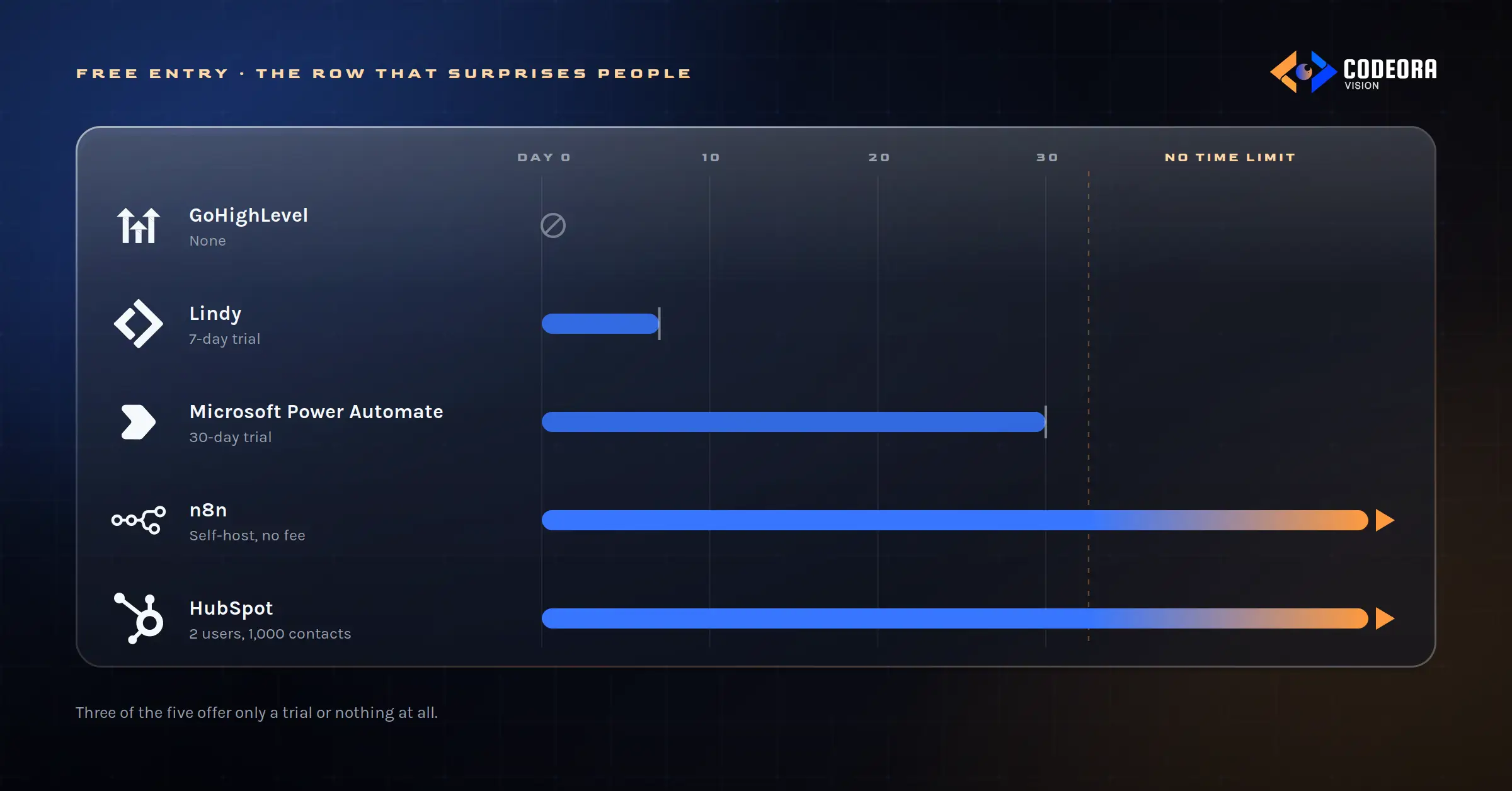
| Free entry | None | 7-day trial | 30-day trial | Self-host, no fee | 2 users, 1,000 contacts |
| Really for | Agencies, multi-location | AI agents | Microsoft estates | Long technical workflows | CRM-bound work |
| Who maintains it | Agency operator | Ops generalist | IT or M365 admin | Technical owner | CRM admin |
| Overage behaviour | Usage-based AI charges | Pauses, no overage bill | Licence-dependent | Execution cap | Credit-dependent |
| Learning curve | Steep, broad surface | Shallow | Middle | Steepest | Shallow inside the CRM |
Free entry is the row that surprises people. Three of the five offer only a trial or nothing at all.
KEY TAKEAWAY
GoHighLevel starts at $97 monthly, Lindy at $29.99 per user, and Power Automate Premium at $15 per user paid yearly. Only HubSpot offers a genuinely permanent free tier among the five.
Choose on what the tool is actually for, then who maintains it, then price. The AI workflow automation tools for small business decision resolves quickly once the first two are settled. Headline price is the weakest of the three signals.
Pick GoHighLevel when the business is an agency or multi-location operation and CRM, marketing, and automation should live in one system.
Lindy fits when the work needs AI agents that decide rather than rules that fire. Per-user pricing stays sane only while the team is small.
Power Automate wins when Microsoft 365 is already the estate and IT will own the result.
n8n is right when workflows are long, AI steps loop and retry, and someone technical will maintain it.
HubSpot is right when the bottleneck is the CRM and a CRM admin already exists.
Buy none of them when the process spans four or more systems and nobody owns it internally. At that point the choice is not a tool but whether to build properly. That is where agentic workflow automation built on n8n and LangGraph applies.
A sequence beats a single decision. Start where friction is lowest, then migrate the few workflows that become expensive.
KEY TAKEAWAY
Choose AI workflow automation software on purpose first, maintenance ownership second, and price third. GoHighLevel suits agencies, Lindy suits AI-agent work, and Power Automate suits an existing Microsoft estate.
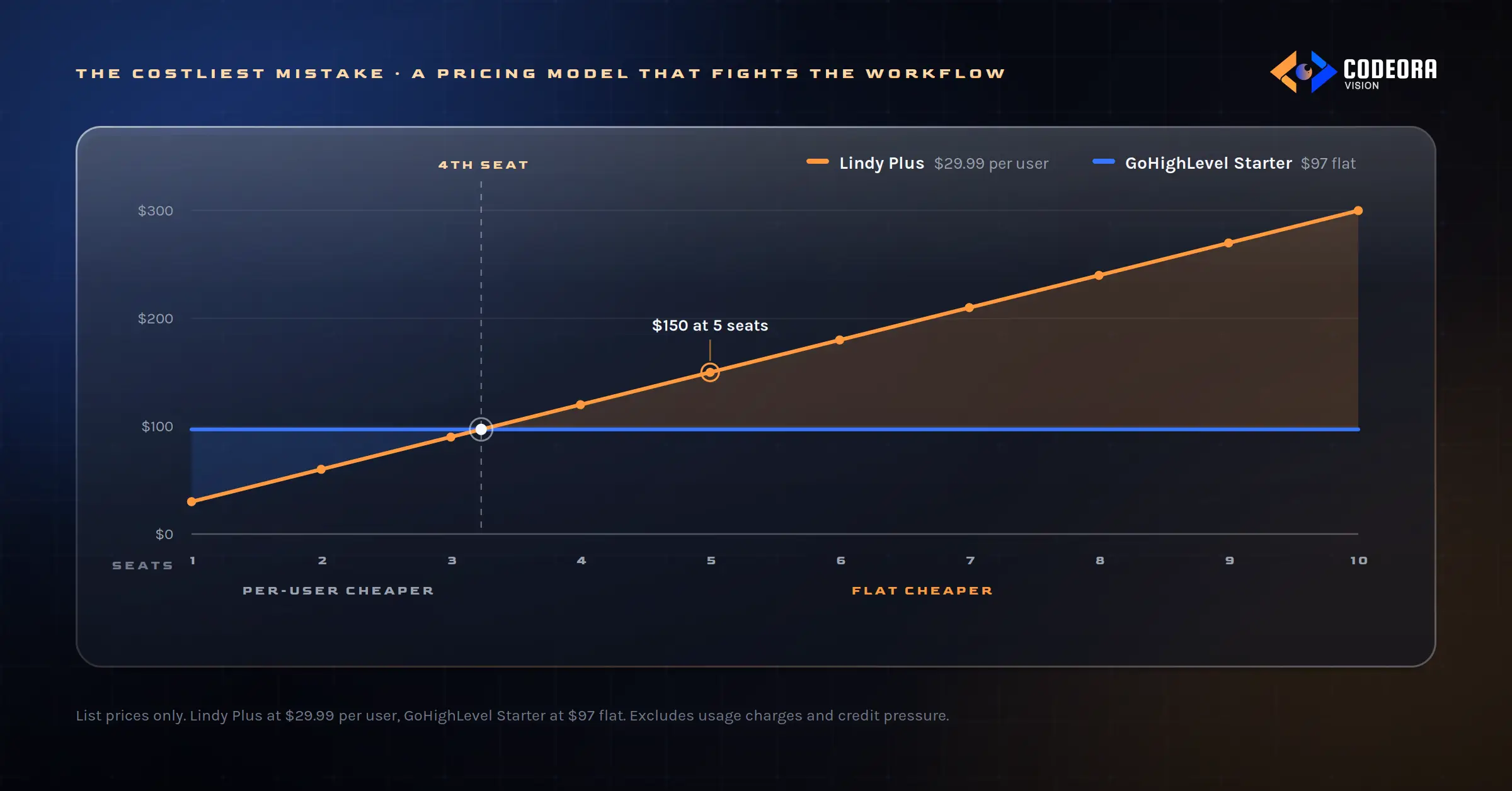
The costliest mistake is buying a pricing model that fights the workflow. A five-person team on Lindy Plus pays roughly $150 monthly before credit pressure. GoHighLevel charges the same $97 whether one person uses it or ten. Headcount, not features, decides which of those is wasteful.
Treating a trial as a free tier. Lindy offers 7 days and Power Automate 30. Only HubSpot's free tier persists, and it stops at 2 users and 1,000 contacts.
Automating an undocumented process. If three people do a task three ways, the automation encodes whichever version got described.
Assuming self-hosting is free. n8n's Community Edition has no licence fee and real operational cost, including upgrades, backups, and incident response.
Trusting AI steps to be consistent. The tau-bench study, published June 2024 by Yao, Shinn, Razavi, and Narasimhan, found leading function-calling models solve under 50% of multi-step tasks. Consistency was worse, with pass^8 below 25% in retail. Gartner separately forecast over 40% of agentic AI projects may be cancelled by 2027.
We are not a platform and we do not compete with the nine above. We build on them, and we recommend against a build more often than for one.
Our default is HubSpot or GoHighLevel where the business is CRM-shaped and an operator will own it. Lindy suits teams that want agent behaviour without engineering. n8n with LangGraph handles workflows that genuinely need orchestration. Most agencies still build with last year's stack — we build with LangGraph, MCP, Claude — agent-native, not retrofitted. Frameworks such as LangChain, CrewAI, Pydantic AI, and Temporal cover adjacent ground.
Published pricing, per Lock 8: single-channel builds from $5,000, multi-channel with CRM or PMS integration from $10,000, and custom multi-agent work at $20,000–$30,000+. Monthly is flat support, quoted with scope. Where a $9 subscription solves the problem, we say so, and we say so often.
The honest constraint: What we publish alongside the architecture is the outcome. Every deployment we describe is anonymized by vertical under client confidentiality, and every figure reflects a single engagement rather than a guaranteed result. One system we can show you in full is our own: the multi-agent SEO pipeline that took two to three people 20 to 25 hours per output and now takes one person one hour. No NDA on that one — ask and we will run it live.
KEY TAKEAWAY
The most expensive mistake is buying a pricing model that fights the workflow. A five-person Lindy Plus team pays roughly $150 monthly, while GoHighLevel charges $97 whether one person uses it or ten.
HubSpot, if a CRM is the bottleneck, because its free tier costs nothing for up to 2 users and 1,000 contacts. Among paid options, Power Automate Premium at $15 per user monthly paid yearly undercuts Lindy Plus at $29.99 and GoHighLevel at $97. Self-hosted n8n has no licence fee but transfers hosting and upgrades to you.
Yes, for one-system and two-system workflows. GoHighLevel, Lindy, and HubSpot are all built for non-technical operators. The constraint appears at the third system and at error handling. McKinsey's 2025 State of AI survey (n=1,993) found only 23% of organizations scaling an agentic system, and integration capacity is a common reason.
They solve different problems. GoHighLevel bundles CRM, marketing, and automation from $97 monthly with unlimited users, which suits agencies and multi-location operations. Lindy runs AI agents at $29.99 per user monthly, which suits small teams wanting autonomous work rather than rules. Headcount decides it: GoHighLevel's flat fee beats per-user pricing above roughly four users.
Only for work inside the CRM. Its free tier covers up to 2 users and 1,000 contacts. Starter listed at $7 per seat monthly promotional, against a $20 list price, including 500 HubSpot Credits. Once a workflow must reach a system HubSpot does not natively connect, a dedicated platform does the job better.
It handles input that varies. Rule-based automation matches fixed fields and breaks when a template changes. An AI step reads an invoice or form regardless of layout and passes structured output onward. Lindy is built entirely around this. The honest limit is reliability, and tau-bench found leading models solve under 50% of multi-step tasks.
Budget subscription and maintenance separately, because the second is larger. Named-tool entry tiers run from $15 per user on Power Automate to $97 monthly on GoHighLevel, verified August 31, 2026. The bigger line is whoever keeps workflows running when an API changes. An agency build starts at $5,000 for single-channel work.
Pick one that is high-volume, already written down, and has a checkable success condition. Inbound enquiry routing, order-status replies, invoice intake, and appointment reminders meet those tests. Avoid starting with a process nobody can describe in writing, because an undocumented process cannot be automated, only encoded.
Only HubSpot, among the five named tools, and it stops at 2 users and 1,000 contacts. Lindy offers a 7-day trial and Power Automate 30 days. GoHighLevel offers none at all. Self-hosted n8n has no licence fee, which is the closest thing to free, though it transfers hosting and maintenance to you.
Sources cited in this post: GoHighLevel pricing · Lindy pricing · Microsoft Power Automate pricing · n8n pricing · HubSpot CRM pricing · Yao, Shinn, Razavi, Narasimhan, τ-bench, arXiv 2406.12045
Related Codeora Vision resources: agentic workflow automation built on n8n and LangGraph · custom agentic AI solutions and multi-agent architecture · AI chatbot development services for support teams · private LLM and RAG knowledge systems · automated lead generation for outbound teams · AI automation services for operations teams · ecommerce automation for Shopify merchants · the six types of AI automation for small business · AI agent vs AI chatbot: which one the work needs · n8n vs Zapier vs Make compared on billing model
RELATED CODEORA VISION SERVICES
Agentic orchestration built on n8n and LangGraph, with retries, audit logs, and human approval gates on every write.
ExploreMulti-agent architecture for processes that span four or more systems and have outgrown any canvas.
ExploreRetrieval-grounded chat that answers from your own documents and deflects tickets without inventing policy.
ExploreRELATED BLOGS
Compared on pricing model, licensing, and AI agent support, with every figure read from a vendor pricing page.
12 min read AUTOMATIONThe six automation types, the five real cost drivers, and why most generative AI pilots return nothing.
13 min read AGENT ARCHITECTUREA chatbot answers, an agent acts. When each one is the right call, and what the reliability ceiling means.
9 min readFREE CONSULTATION
30 minutes, under NDA. We map your workflows, forecast spend on the real billing unit, and tell you when a $9 subscription is the right answer.
Book a free consultationNo spam. No sales sequence.