
ON THIS PAGE
PUBLISHED AUGUST 9, 2026 · LAST UPDATED AUGUST 9, 2026
By the Codeora Vision team — AI Systems Architect
The AI agent vs AI chatbot distinction comes down to one thing: a chatbot answers, an agent acts. A chatbot's output is a reply. An agent's output is a changed record in an external system. The practical gap is reliability, not intelligence. Benchmark work found leading function-calling models solve under half of multi-step tasks (τ-bench, June 2024). Chatbots built through AI chatbot development run on models such as GPT-4o. Agents add orchestration such as LangGraph and write access to systems such as Zendesk.
A chatbot responds to a prompt and stops. An AI agent takes a goal, breaks it into subtasks, calls tools to execute them, and checks its own results. McKinsey's 2025 State of AI survey (n=1,993) found 23% of organizations scaling an agentic system, with a further 39% experimenting.
The difference is architectural, not a matter of model quality. Both can run on the same model. What separates them is whether the software can reach outside the conversation.
Ask a chatbot about a delayed order on an ecommerce site and it explains the returns policy. Ask an agent and it queries Shopify, reads the tracking record, updates the ticket in Gorgias, and emails the customer.
Three capabilities define the boundary. Tool access, meaning the ability to call an external API. A reasoning loop, usually plan-act-observe, so the system can re-plan when a step fails. State, so it remembers what it already did.
KEY TAKEAWAY
A chatbot's output is a reply and an AI agent's output is a changed record in an external system. McKinsey's 2025 State of AI survey (n=1,993) found 23% of organizations scaling an agentic system and 39% experimenting.
Buying the wrong category is expensive in both directions. Gartner forecast in August 2025 that over 40% of agentic AI projects may be cancelled by 2027. Buying an agent for work a chatbot handles is the most common way to join that number.
The reverse error costs less but caps the return. A chatbot cannot close a ticket, so every resolution still needs a human.
Scale data shows how far ahead the marketing runs. McKinsey found that in any given business function, no more than 10% of organizations are scaling AI agents. Meanwhile Gartner projects task-specific agents inside 40% of enterprise applications by the end of 2026, up from under 5%.
MIT Media Lab's Project NANDA reported roughly 95% of organizations seeing no measurable profit-and-loss return from generative AI pilots. That finding appeared in The GenAI Divide: State of AI in Business 2025.
KEY TAKEAWAY
Gartner forecast over 40% of agentic AI projects may be cancelled by 2027, and category choice drives much of that gap. McKinsey's 2025 survey found no more than 10% of organizations scaling agents in any single function.
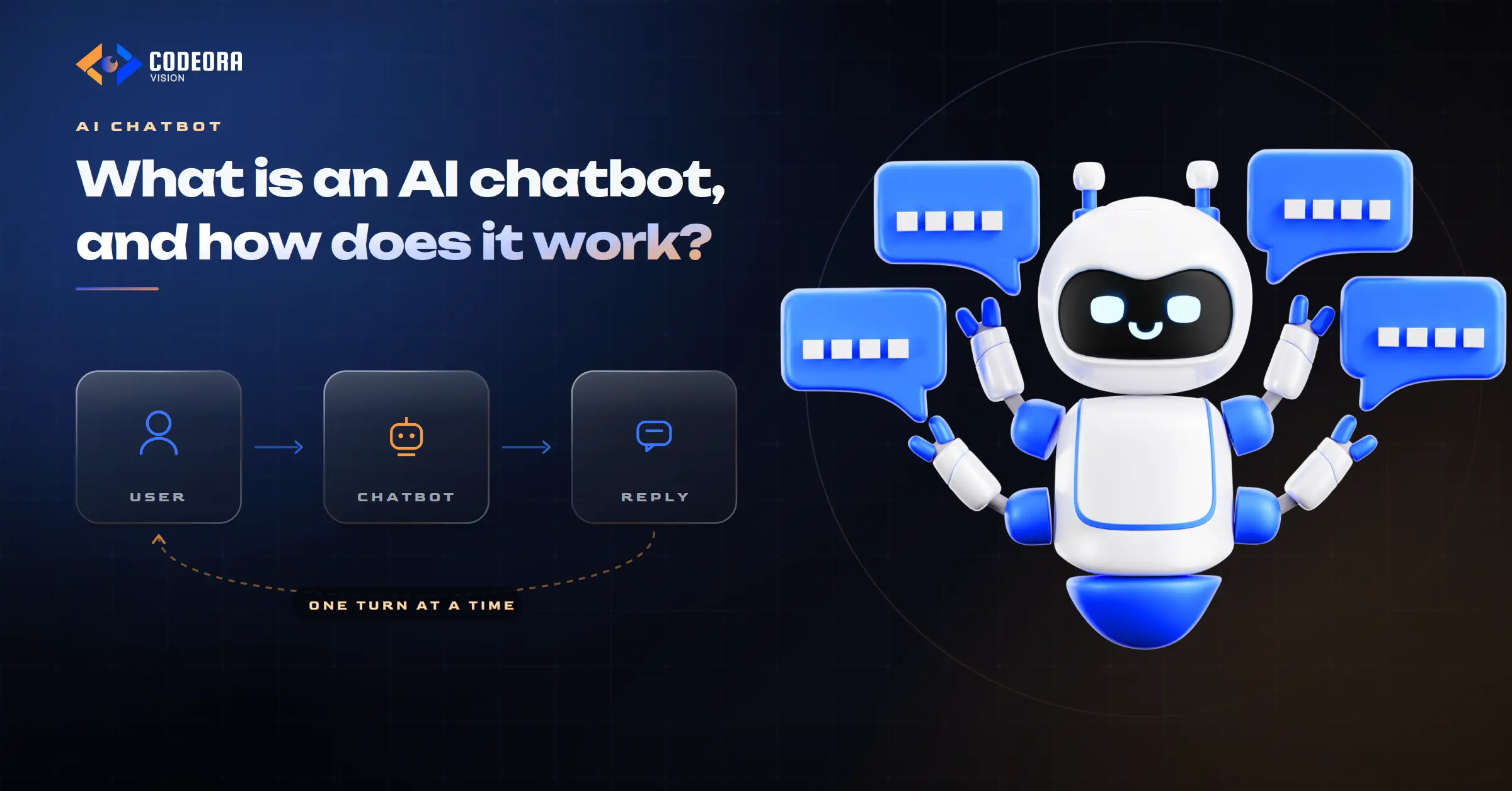
An AI Chatbot is a conversational system that answers questions turn by turn. The user prompts, the system responds, and the interaction pauses until the next prompt. It generates text, retrieves answers, and summarizes documents. It does not act, and nothing changes in external software.
Modern chatbots pair a model with retrieval. RAG and knowledge systems, or Retrieval-augmented generation, lets a model answer from a company's own documents rather than from training data. That is what stops it inventing policy. Menlo Ventures, surveying 600 enterprise IT decision-makers, found RAG in 51% of enterprise LLM deployments.
The stack is short. A model such as GPT-4o, Claude Sonnet, or Gemini 2.5. Retrieval runs over company content. Delivery happens through Intercom, Zendesk, or Gorgias.
Its limits follow directly from the design. No live connection to external software, no independent decisions, and no multi-step work without a human prompting each turn.
KEY TAKEAWAY
An AI chatbot answers turn by turn and cannot act on external systems without a human prompting each step. Menlo Ventures (n=600) found retrieval-augmented generation in 51% of enterprise LLM deployments.
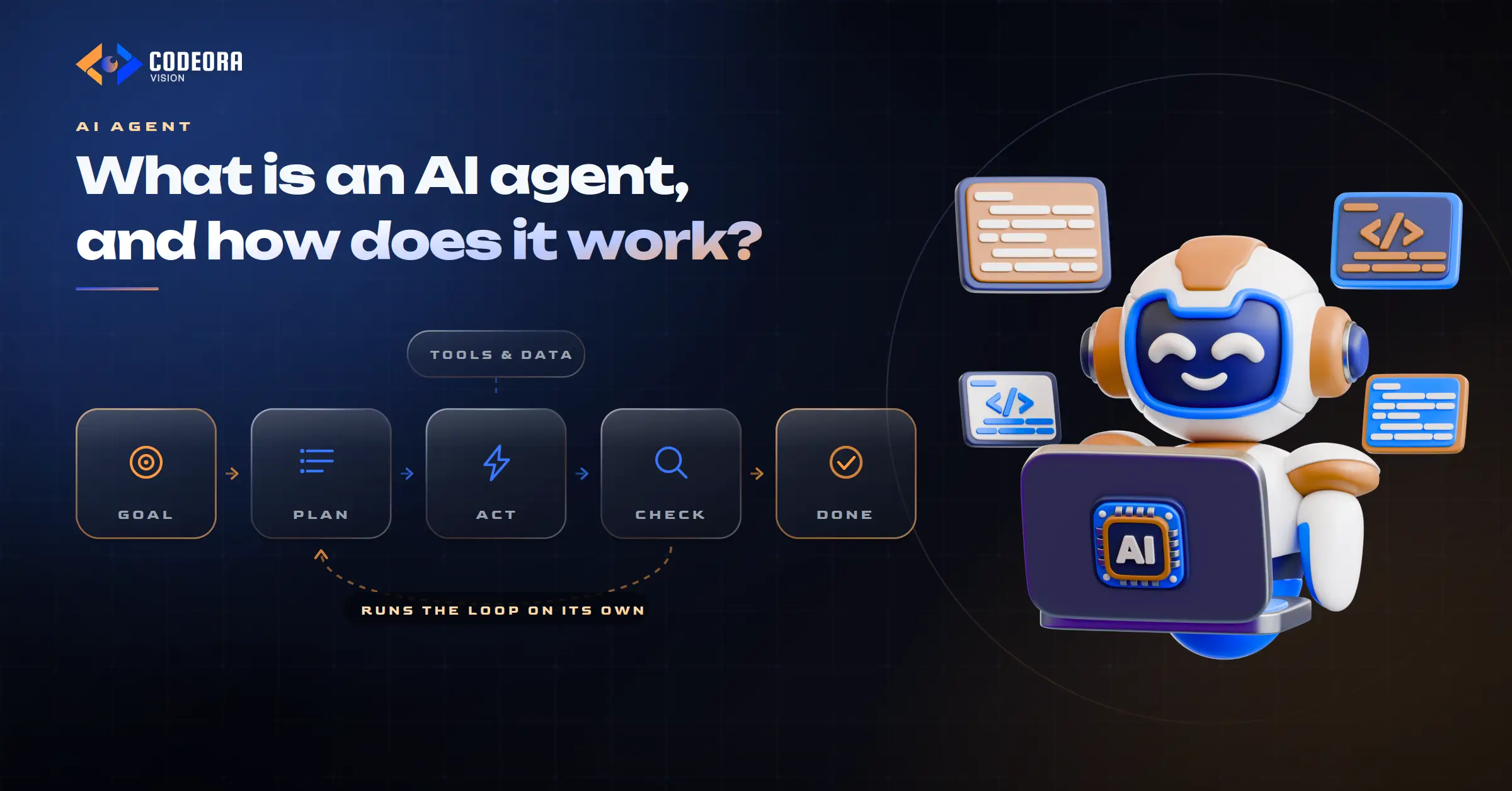
An AI agent is a goal-driven system that plans, acts, and observes in a loop until an objective is met. It accepts a high-level goal, decomposes it into subtasks, executes them through tools, and self-corrects when a step returns an error.
Function calling is what makes this possible. The model emits a structured request, the orchestration layer executes it against a real API, and the result returns as the next input.
Orchestration is where agents succeed or fail. LangGraph models a process as a state graph, so branching is the normal case rather than an exception. CrewAI, Pydantic AI, the OpenAI Agents SDK, and the Claude Agent SDK solve adjacent parts of the same problem.
The Model Context Protocol, or MCP, is the standard that lets an agent reach a live system of record instead of guessing from training data. Menlo Ventures found fine-tuning accounts for just 9% of production models, which confirms the pattern.
KEY TAKEAWAY
An AI agent runs a plan-act-observe loop with tool access, built on orchestration such as LangGraph, CrewAI, or the OpenAI Agents SDK. Menlo Ventures found fine-tuning accounts for only 9% of production models.
Three terms, three capability classes, routinely used as synonyms. A chatbot answers. A virtual agent completes a defined transaction inside a designed flow. An AI agent pursues a goal and chooses its own steps. The separating question is who decides the sequence.
| CRITERION | CHATBOT | VIRTUAL AGENT | AI AGENT |
|---|---|---|---|
| Primary job | Answer a question | Complete a defined transaction | Pursue a goal |
| Output | A reply | A completed booking or form | A changed record across systems |
| Who decides the sequence | The user | The flow designer, in advance | The system, at runtime |
| Tool and API access | None or read-only | Fixed, pre-wired integrations | Open-ended, selects its own tools |
| Unplanned input | Answers or fails | Escalates to a human | Attempts, and may self-correct |
| Characteristic failure | A wrong answer | A dead-end flow | A wrong action, taken autonomously |
| Typical stack | GPT-4o plus Intercom | Designed flows plus Zendesk | LangGraph, MCP, Claude |
Virtual agent is the term most often stretched. Vendors apply it to both scripted flows and autonomous systems, so the label alone does not tell a buyer what they are getting.
KEY TAKEAWAY
A chatbot answers, a virtual agent completes a pre-designed transaction, and an AI agent chooses its own steps at runtime. The separating question is who decides the sequence, not which model is used.
Use an AI chatbot when the output a user needs is information, not action.. Question answering, policy lookup, document summarization, and product guidance all resolve inside the conversation. Ticket deflection is the classic case. Adding autonomy to that work buys risk without buying capability.
The reliability data is the strongest argument, and it comes from the agent research itself. The τ-bench study, published June 2024 by Yao, Shinn, Razavi, and Narasimhan, found state-of-the-art function-calling models succeeded on under 50% of tasks. Consistency was worse. Repeating the same task eight times, pass^8 fell below 25% in the retail domain.
An agent that succeeds once and fails on repetition is not a support system. It is a support system plus a review queue.
Klarna's trajectory illustrates the cost of over-reaching. Its February 2024 press release reported the AI assistant handling 2.3 million conversations in one month. That was two-thirds of customer service chats, doing the work of 700 full-time agents. Resolution time fell from 11 minutes to under 2. By May 2025 the company was rehiring human agents. Its chief executive told Forbes that overemphasis on cost-cutting had produced poorer service.
Choose an agent when the work spans systems, repeats often, and has a checkable success condition. Choose a chatbot for everything else.
AT A GLANCE
Chatbot: answers, output is a reply, no external write access. Correct for question answering and ticket deflection.
Virtual agent: completes a transaction inside a flow designed in advance. Escalates on anything unplanned.
AI agent: pursues a goal, selects its own tools, writes to external systems. Correct for multi-step work across software.
Reliability ceiling: leading function-calling models solved under 50% of τ-bench tasks, with pass^8 under 25% in retail (Yao et al., June 2024).
Adoption reality: 23% of organizations scaling agentic systems, no more than 10% in any single function (McKinsey, 2025, n=1,993).
AI agent vs AI chatbot, decided: if the required output is information, use a chatbot. If it is a changed record in software, use an agent.
KEY TAKEAWAY
A chatbot is the correct choice when the needed output is information rather than action. τ-bench found leading function-calling models below 50% task success and under 25% pass^8 consistency in retail (June 2024).
We treat the reliability numbers above as a design constraint, not a discouragement. Most agencies still build with last year's stack — we build with LangGraph, MCP, Claude — agent-native, not retrofitted.
Here is how we architect this decision in practice, and what we do not promise.
Discovery separates the work into two lists: questions to answer and actions to take. Anything on the first list ships as a chatbot with retrieval. Only the second list justifies an agent.
For the agent portion, the build pattern is consistent. A trigger arrives from Shopify, HubSpot, or a form. Claude Sonnet or GPT-4o handles classification. Next comes a LangGraph state graph holding the sequence, with the smallest viable tool set and an explicit uncertainty branch routing to a human. Connectors write through MCP. The evaluation harness carries a scored test set, built before launch.
The honest constraint: What we publish alongside the architecture is the outcome. Every deployment we describe is anonymized by vertical under client confidentiality, and every figure reflects a single engagement rather than a guaranteed result. One system we can show you in full is our own: the multi-agent SEO pipeline that took two to three people 20 to 25 hours per output and now takes one person one hour. No NDA on that one — ask and we will run it live.
For builds spanning several coordinated agents, that work sits in custom agentic AI solutions and multi-agent architecture.
KEY TAKEAWAY
Codeora Vision splits scoped work into two lists: questions to answer and actions to take. The question list ships as a retrieval chatbot, and only the action list justifies a LangGraph agent.
FREE ARCHITECTURE REVIEW
A 30-minute review under NDA. We split your workload into questions and actions, size the integration surface, and hand you the plan — with us or without us.
Book a free consultationNot by upgrading the model. A chatbot becomes an agent when three things are added. Tool access to call external systems, a reasoning loop to plan and re-plan, and state to remember completed steps. Swapping GPT-4o for a newer model changes answer quality, not capability class. The work sits in the orchestration layer, using frameworks such as LangGraph or CrewAI.
In its base form it is a chatbot: it answers turn by turn and its output is a reply. It becomes agent-like only when the three defining capabilities are wired in — tool access to call external APIs, a plan-act-observe reasoning loop, and state to remember completed steps. Without those, model quality changes but the capability class does not.
No. They serve different jobs. A chatbot is correct when the needed output is information, such as question answering or ticket deflection; an agent is correct when the output is a changed record across systems. The practical approach is to ship the question list as a chatbot with retrieval and reserve an agent for the action list, because adding autonomy to information work buys risk without buying capability.
Conversational AI answers turn by turn and its output is a reply, usually grounded by retrieval. Agentic AI pursues a goal, runs a plan-act-observe loop, selects its own tools, and writes to external systems. The separating question is who decides the sequence — the user, a flow designer in advance, or the system at runtime.
Typically yes. A reply-only chatbot needs a model and retrieval, while an agent adds an orchestration layer, tool calls against real APIs, state, and an evaluation harness, plus a human review path for uncertain steps. That review path is not optional given the reliability ceiling: leading function-calling models solved under 50% of τ-bench tasks (Yao et al., June 2024).
Keep the tool set as small as the job allows, add an explicit uncertainty branch that routes to a human, and put a scored evaluation harness in place before launch. Codeora Vision's build pattern uses the smallest viable tool set and a LangGraph state graph with a human-routing branch, precisely because leading function-calling models fall below 50% task success and under 25% pass^8 consistency in retail (τ-bench).
Sources cited in this post: Yao, Shinn, Razavi, Narasimhan, τ-bench, arXiv 2406.12045, June 17, 2024 · Klarna press release, February 27, 2024 · Forbes, Klarna reverses on AI, May 18, 2025 · McKinsey, The State of AI in 2025 · Menlo Ventures, 2024: The State of Generative AI in the Enterprise · MIT Media Lab Project NANDA, The GenAI Divide
RELATED CODEORA VISION SERVICES
Multi-agent architecture built on LangGraph and MCP, scoped to the actions your business actually needs taken.
ExploreRetrieval-grounded chat that answers from your own documents and deflects tickets without inventing policy.
ExploreAgentic orchestration across systems, with retries, audit logs, and human approval gates on every write.
ExploreRELATED BLOGS
The six automation types, the five real cost drivers, and why most generative AI pilots return nothing.
13 min read RAGChunking, reranking, and eval design for retrieval systems that ground answers instead of hallucinating.
11 min read AGENT ARCHITECTUREThe four architectural mistakes that quietly kill agent projects before launch, and what agent-native design fixes.
9 min readFREE CONSULTATION
30 minutes, under NDA. We split your workload into questions to answer and actions to take, then tell you which one you actually need.
Book a free consultationNo spam. No sales sequence.