
ON THIS PAGE
PUBLISHED AUGUST 8, 2026 · LAST UPDATED AUGUST 8, 2026
AI automation for small business means software that reads context, decides, and acts across the tools a company already runs. It differs from rule-based automation, which breaks the moment input varies. Adoption is real: 58% of small businesses used generative AI in 2025, up from 40% in 2024 (U.S. Chamber of Commerce, August 2025). Working systems pair a model such as Claude Sonnet with an orchestration layer such as LangGraph and a system of record such as HubSpot.
AI automation is software that interprets an input, decides what to do, and executes the action in a live system. Rule-based automation matches patterns. AI automation handles variation. McKinsey found 88% of organizations now use AI in at least one business function, but only 23% are scaling an agentic system.
The distinction is not cosmetic. A rule-based workflow routing invoices needs the vendor name in a fixed field. Change the template and it fails. An AI-driven step reads the document, extracts the vendor regardless of layout, and routes it.
That capability comes from connecting a language model to real data. Retrieval-augmented generation, or RAG, is the technique that lets a model answer from a company's own records rather than from training data. That is what stops it inventing an answer. Menlo Ventures, surveying 600 enterprise IT decision-makers, found RAG reached 51% of enterprise LLM deployments, up from 31% the prior year.
Most small businesses have the first layer already. Very few have the second.
KEY TAKEAWAY
AI automation interprets variable input, while rule-based automation only matches fixed patterns. McKinsey's 2025 State of AI survey (n=1,993) found 88% of organizations use AI somewhere, but only 23% scale an agentic system.
Small business automation moved from optional to competitive in roughly two years. Generative AI use among small businesses rose from 23% in 2023 to 40% in 2024 to 58% in 2025. That series comes from U.S. Chamber of Commerce research with Teneo Research, published August 18, 2025. It is a doubling inside 24 months.
Two findings from the same study matter more than the headline number. First, 82% of small businesses using AI increased their workforce over the past year, which undercuts the replacement narrative. Second, 96% of small business owners plan to adopt further emerging technologies.
Vendor research points the same direction with appropriate caution. Salesforce found 75% of SMBs at least experimenting with AI and 91% of AI-using SMBs reporting a revenue lift. That data comes from the sixth edition of its Small and Medium Business Trends Report, surveying 3,350 SMB leaders. Salesforce sells software to this market, so treat the second figure as directional.
The spending curve is steeper than the adoption curve. IDC's Worldwide AI and Generative AI Spending Guide, published August 26, 2025, projects 31.9% annual growth through 2029, reaching 1.3 trillion dollars.
KEY TAKEAWAY
Generative AI use among US small businesses went from 23% in 2023 to 58% in 2025, and 82% of AI-using small businesses grew headcount. Source: U.S. Chamber of Commerce with Teneo Research, August 18, 2025.
Every working system has four layers: a trigger, a model that interprets, an orchestration layer, and a connector. The orchestration layer decides sequence and the connector writes to a system of record. Remove the fourth layer and the system produces suggestions rather than outcomes.
The trigger is an event. A form submission, an inbound call through Twilio, a new order in Shopify, an email landing in a shared inbox.
The model reads it. Claude Sonnet, GPT-4o, Gemini 2.5, Llama 3.3, and Mistral Large all handle classification and extraction competently at this layer. Model choice matters less than most buyers expect.
Orchestration is where systems succeed or fail. LangGraph models a process as a state graph, so branching is the normal case rather than an exception. That keeps an agent coherent when a step returns something unexpected. LangChain, CrewAI, Pydantic AI, and Temporal solve adjacent parts of the same problem. Visual tools such as n8n and Make.com cover simpler paths without code.
The connector layer writes back. Menlo Ventures found fine-tuning accounts for just 9% of production models, which confirms the pattern: connect the model to owned data instead of retraining it.
KEY TAKEAWAY
A production AI automation has four layers — trigger, model, orchestration, connector — and the connector is the one most pilots skip. Menlo Ventures found fine-tuning accounts for only 9% of production models, versus 51% for retrieval-augmented generation.
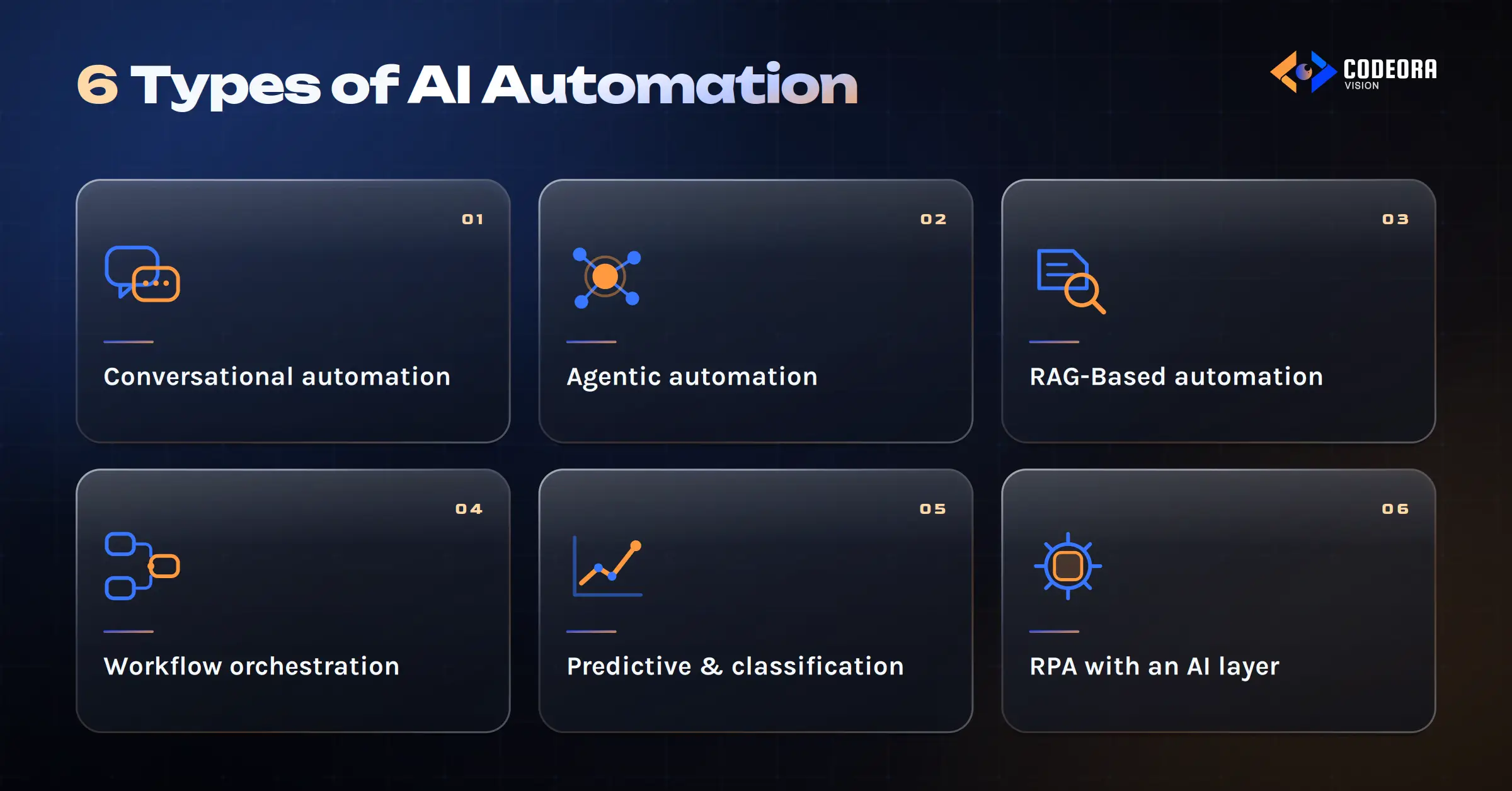
Six types cover almost every small business deployment. They differ in what they read, what they change, and how much they cost to keep running. Gartner forecast in August 2025 that 40% of enterprise applications will embed task-specific AI agents by the end of 2026, up from under 5%.
The most common buyer confusion sits between the first two rows. A chatbot answers. An agent acts. That single distinction predicts project cost better than any other variable.
Answers questions inside a chat or call. Output is a reply.
STACK
Claude Sonnet or GPT-4o, Gorgias, Twilio
BEST FIT
Support deflection, FAQ handling, call answering
Takes multi-step action in external systems. Output is a changed record.
STACK
LangGraph, CrewAI, Model Context Protocol, HubSpot
BEST FIT
Order handling, intake, qualification, scheduling
Reads and answers from a company's own documents.
STACK
LlamaIndex, Pinecone, Claude Opus
BEST FIT
Contract review, policy lookup, internal search
Connects systems and sequences steps across them.
STACK
n8n, Make.com, Temporal
BEST FIT
Multi-system handoffs, data sync, approvals
Scores, ranks, or routes based on patterns in historical data.
STACK
Llama 3.3, Gemini 2.5, Klaviyo
BEST FIT
Lead scoring, churn flags, demand forecasting
Replays UI actions, with a model normalizing input first.
STACK
Robotic process automation tools plus Mistral Large
BEST FIT
Legacy systems with no usable API
Types 1 and 4 are widely productized and cheap to buy. Types 2 and 3 usually require building. McKinsey found that in any given business function, no more than 10% of organizations are scaling AI agents. That is where the competitive gap currently sits.
KEY TAKEAWAY
An AI chatbot returns a reply and an AI agent returns a changed record, which is the split running through all six types. Gartner forecasts task-specific agents in 40% of enterprise applications by the end of 2026, up from under 5%.
Five variables set the price, and model inference is rarely the largest. Integration count comes first. A process touching one system costs a fraction of one touching four, because each connector carries its own authentication, rate limits, error states, and maintenance.
The other four drivers are API availability, decision volume, the accuracy floor, and the compliance regime. A system with no usable API needs RPA or a scraping layer, which raises both build and maintenance cost. An accuracy floor of 99% costs considerably more than one of 90%. The last few points are bought with evaluation harnesses and human review paths.
Return data exists but should be read carefully. Organizations reported 3.70 dollars returned per dollar invested in generative AI, with value typically realized in about 13 months. That finding comes from a 2024 IDC study sponsored by Microsoft, covering more than 4,000 business leaders. Microsoft sponsored that research and sells the products measured.
Ongoing cost is the line most buyers underestimate. Inference, monitoring, evaluation runs, and connector maintenance continue for the life of the system.
KEY TAKEAWAY
AI automation cost is driven by integration count, API availability, decision volume, accuracy floor, and compliance regime, not by model inference. IDC's Microsoft-sponsored 2024 study of 4,000+ leaders reported 3.70 dollars returned per dollar and payback at about 13 months.
Evaluate on integration depth, failure behaviour, and exit cost. Feature lists converge quickly in this market, so they separate vendors poorly. Gartner forecast in August 2025 that over 40% of agentic AI projects may be cancelled before the end of 2027. Vendor durability is therefore a real criterion.
Ask what happens when the model is uncertain. A tool with no confidence threshold and no human handoff will fail silently, and silent failure in customer-facing work is more expensive than an outage.
Ask which systems it writes to, not which it reads from. Read-only integrations are easy and low-value. Write access to HubSpot, Shopify, Klaviyo, or Calendly is where the operational efficiency actually comes from.
Then check portability. Prompts, evaluation sets, and process logic built inside a closed platform do not move. Systems built on open frameworks such as LangChain, LlamaIndex, or n8n keep that work transferable.
For anything spanning three or more systems, compare buying against agentic workflow automation built as a system. Platform tools tend to stop at the second handoff.
KEY TAKEAWAY
Evaluate AI automation tools on write access, uncertainty handling, and portability rather than feature count. Gartner forecast in August 2025 that over 40% of agentic AI projects may be cancelled by the end of 2027.
Implementation runs in five stages: process documentation, integration audit, narrow pilot, evaluation harness, then expansion. Skipping the first stage is the most common and most expensive mistake, because an undocumented process cannot be automated. Most small business deployments spend more calendar time on the second stage than on model work.
Start by writing the process down as it actually runs, including the exceptions. Most teams discover at this point that three people handle the same task three different ways.
The integration audit comes next. For each system involved, confirm API access, authentication method, rate limits, and whether the data needed is actually exposed. This audit routinely reshapes scope.
Pilot on one process with high volume and clear success criteria. Speed matters more than most teams assume. The median law firm takes 13 minutes to respond to a lead form, and response latency is measurable on day one. That benchmark comes from Hennessey Digital's 2025 Lead Form Response Time Study.
Build the evaluation harness before expanding. Without a scored test set, nobody can tell whether a prompt change improved the system or quietly degraded it. Tooling for this exists in private LLM and RAG knowledge systems work and applies equally here.
KEY TAKEAWAY
AI automation implementation runs process documentation, integration audit, narrow pilot, evaluation harness, expansion. Hennessey Digital's 2025 study found a 13-minute median law-firm lead response time, which makes response latency a measurable day-one pilot metric.
Automation lands differently by sector, and the highest-return examples are the ones where a measured baseline already exists. Legal, dental, and ecommerce all have published baselines, which makes them useful illustrations. Each of the three below pairs a named source with a quantified starting point.
Legal. AI usage among legal professionals reached 79%, up from 19% in 2023. That figure comes from Clio's Legal Trends Report 2025, published October 16, 2025 and conducted with Neuro-Insight. Firms using online intake tools reported 50% more incoming potential clients and 50% more revenue on average. Clio's earlier 2024 secret-shopper study found only 33% of firms responded to prospect emails, down from 40% in 2019. Intake automation targets exactly that gap, and it routes naturally to law firm intake services and matter automation.
Dental and healthcare. Vendor datasets, including a February 2026 Peerlogic analysis of a 26-location group, put unanswered inbound calls at 30% to 38%. These are vendor first-party figures, not independent research. Call-handling automation addresses a quantified loss rather than a hypothetical one.
Ecommerce. Order-status handling, returns triage, and post-purchase messaging are the standard first three automations. They run across Shopify, Gorgias, and Klaviyo, and connect to ecommerce automation for Shopify merchants.
KEY TAKEAWAY
The strongest AI automation examples target measured baselines, such as legal AI usage at 79% in 2025, up from 19% in 2023. Clio's Legal Trends Report 2025 also found only 33% of firms responded to prospect emails in its 2024 secret-shopper study.
They fail on integration and process definition, not on model quality. MIT Media Lab's Project NANDA analyzed 300 public AI deployments, 150 leader interviews, and a 350-person employee survey. That work was published as The GenAI Divide: State of AI in Business 2025. Roughly 95% of organizations reported no measurable profit-and-loss return from generative AI pilots.
MIT attributes this to a learning gap, meaning the inability to fit models into existing workflows, structures, and culture. The 5% that captured value integrated deeply into one process rather than shallowly across many.
Three failure modes recur, and all three are honest limitations of the approach rather than vendor problems.
Integration debt. A system without a usable API forces brittle workarounds that break on the vendor's next UI change. This is a real ceiling, not a solvable one.
No evaluation harness. Teams ship a prompt, change it, and have no way to detect regression. Accuracy drifts quietly.
Automating an undefined process. If three staff do a task three ways, the automation encodes whichever version was described.
There is also a category of work that should stay human. Ambiguous complaints, anything with legal exposure, and any decision where being wrong costs more than being slow.
KEY TAKEAWAY
MIT Media Lab's Project NANDA found roughly 95% of organizations saw no measurable P&L return from generative AI pilots. The gap is workflow integration, not model quality, and Gartner forecast over 40% of agentic AI projects may be cancelled by 2027.
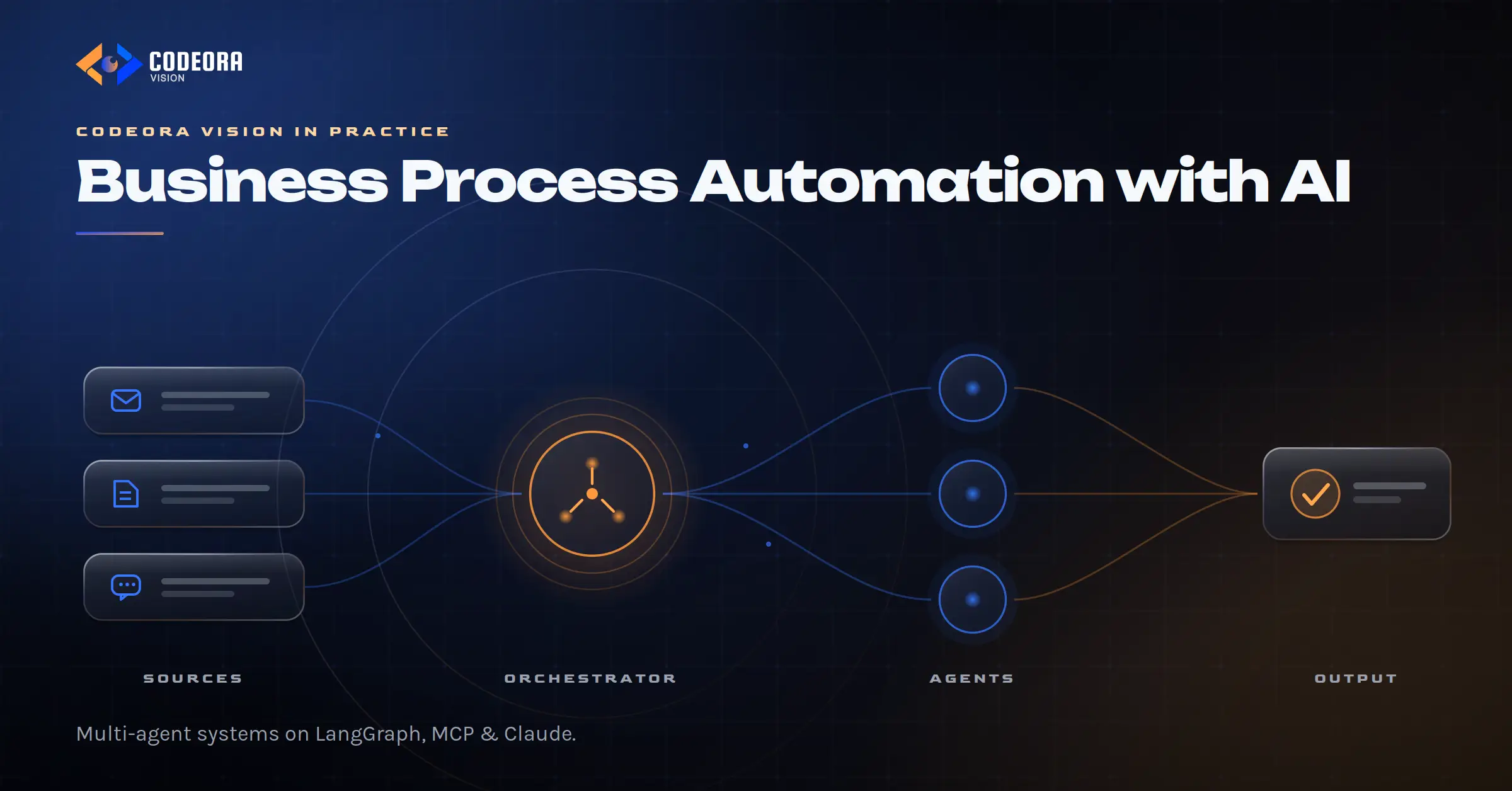
We build these systems as state machines, not as prompt chains. Most agencies still build with last year's stack — we build with LangGraph, MCP, Claude — agent-native, not retrofitted. MCP, the Model Context Protocol, is the standard that lets an agent reach a live system of record instead of guessing from training data.
Here is how we architect a first automation for a small business, and what we do not promise.
Discovery maps the process and audits every integration surface before any model work starts. We scope the pilot to one process with a countable baseline, because an outcome without a baseline is a claim rather than proof.
The build pattern is consistent. A trigger arrives from Twilio, a form, or Shopify. Claude Sonnet or GPT-4o handles the classification step. Next comes a LangGraph state graph holding the decision sequence, with an explicit uncertainty branch that routes to a human. Connectors write to HubSpot, Calendly, or Gorgias through MCP. The evaluation harness carries a scored test set, built before launch rather than after.
The honest constraint: What we publish alongside the architecture is the outcome. Every deployment we describe is anonymized by vertical under client confidentiality, and every figure reflects a single engagement rather than a guaranteed result. One system we can show you in full is our own: the multi-agent SEO pipeline that took two to three people 20 to 25 hours per output and now takes one person one hour. No NDA on that one — ask and we will run it live.
For multi-agent builds beyond a single process, that work sits in custom agentic AI solutions and multi-agent architecture.
KEY TAKEAWAY
Codeora Vision builds AI automation as LangGraph state graphs, with explicit uncertainty branches and a scored evaluation harness built before launch. Prompt chains, the common alternative, degrade silently.
FROM READING TO BUILDING
A 30-minute architecture review under NDA. We map one process, audit its integration surface, and hand you a plan you can act on, with us or without us.
Book a free consultationDefinition. AI automation for small business is software that interprets variable input, decides, and writes to a live system. Rule-based automation only matches fixed patterns.
Adoption. 58% of US small businesses used generative AI in 2025, up from 40% in 2024 and 23% in 2023. Source: U.S. Chamber of Commerce with Teneo Research, August 18, 2025.
Six types. Conversational, agentic, document and knowledge, workflow orchestration, predictive and classification, and RPA with an AI layer.
Agent versus chatbot. A chatbot returns a reply. An agent returns a changed record. This distinction drives cost more than model choice.
Architecture. Four layers: trigger, model, orchestration, connector. Pilots that skip the connector produce suggestions rather than outcomes.
Cost drivers. Integration count, API availability, decision volume, accuracy floor, compliance regime. Not model inference.
Return. IDC's Microsoft-sponsored 2024 study of 4,000+ leaders reported 3.70 dollars per dollar invested, payback near 13 months. Vendor-sponsored, so read directionally.
Failure rate. Roughly 95% of organizations saw no measurable P&L return from generative AI pilots (MIT Media Lab Project NANDA, The GenAI Divide, 2025).
Buy versus build. Buy for single-system, single-step work. Build when a process spans three or more systems or carries specific compliance requirements.
First move. Document one high-volume process exactly as it runs, then audit whether the systems involved expose the data needed.
An AI chatbot answers questions inside a conversation and stops when the conversation stops. An AI agent takes action in external systems, so its output is a changed record rather than a reply. Asked about an order, a chatbot describes the returns policy. An agent queries Shopify, reads the tracking record, and updates the ticket in Gorgias.
Five variables set the price, and model inference is rarely the largest: integration count, API availability, decision volume, the accuracy floor, and the compliance regime. A process touching one system costs a fraction of one touching four, and an accuracy floor of 99% costs considerably more than one of 90%. Ongoing cost — inference, monitoring, evaluation runs, and connector maintenance — continues for the life of the system and is the line most buyers underestimate.
The adoption data points that way: 58% of US small businesses used generative AI in 2025, and 82% of AI-using small businesses grew headcount. IDC's Microsoft-sponsored 2024 study reported 3.70 dollars returned per dollar invested with payback near 13 months, though that research is vendor-sponsored and best read directionally. The honest answer depends on having one high-volume process with a countable baseline to automate first.
Rule-based automation, including classic RPA, matches fixed patterns and replays UI actions, so it breaks the moment input varies. AI automation interprets variable input, decides, and writes to a live system. In practice the two combine: RPA with an AI layer replays UI actions with a model normalizing the input first, which suits legacy systems with no usable API.
The types that are widely productized — conversational automation and workflow orchestration — are cheap to buy. Agentic and document-and-knowledge automation usually require building. Buy for single-system, single-step work; build when a process spans three or more systems or carries specific compliance requirements. Platform tools tend to stop at the second handoff.
Implementation runs in five stages: process documentation, integration audit, narrow pilot, evaluation harness, then expansion. Most small business deployments spend more calendar time on the integration audit than on model work, and skipping the documentation stage is the most common and most expensive mistake.
They fail on integration and process definition, not on model quality. MIT Media Lab's Project NANDA found roughly 95% of organizations saw no measurable P&L return from generative AI pilots, attributing it to a learning gap — the inability to fit models into existing workflows. Three failure modes recur: integration debt, no evaluation harness, and automating an undefined process.
Document one high-volume process exactly as it runs, including the exceptions, then audit whether the systems involved expose the data needed. Pilot on that one process with clear success criteria and a countable baseline, because an outcome without a baseline is a claim rather than proof.
Sources cited in this post: U.S. Chamber of Commerce, Empowering Small Business, August 18, 2025 · MIT Media Lab Project NANDA, The GenAI Divide · McKinsey, The State of AI in 2025 · Gartner press release, August 26, 2025 · Menlo Ventures, 2024: The State of Generative AI in the Enterprise · Clio Legal Trends Report 2025
RELATED CODEORA VISION SERVICES
Multi-system orchestration on LangGraph and n8n, with retries, logging, and human approval gates.
ExploreRetrieval-grounded chat that resolves tickets on your site, in-app, and across support channels.
ExploreAutonomous prospecting, enrichment, and multi-channel follow-up wired into your CRM.
ExploreRELATED BLOGS
Call routing, booking, and escalation logic behind a 24/7 front desk that never drops a lead.
9 min read RAGChunking, retrieval scoring, and citation design that keeps AI answers auditable.
11 min read OPERATIONSThe maintenance layer most teams skip — and the monitoring pattern that prevents silent failures.
8 min readFREE CONSULTATION
30 minutes, under NDA. We scope one process, audit the integrations, and hand you the plan.
Book a free consultationNo spam. No sales sequence.